
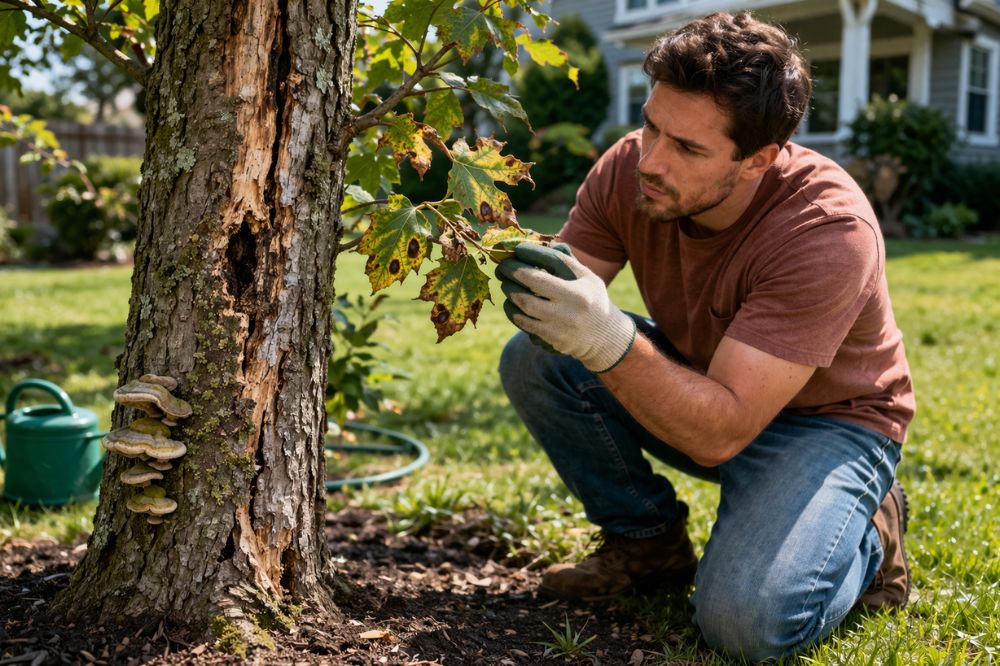
You walk out to get the mail, glance at the big oak by the driveway, and there it is. A pile of loose shell on the ground and a bare patch up the trunk. Bark falling off tree is one of the most common things homeowners call us about, and the honest answer is that it means very different things depending on the tree. Sometimes it is just housekeeping. Sometimes it is the tree telling you it died a year ago and nobody noticed.
Some Trees Shed Bark, and That Is Fine
Bark is not skin. It is armor that gets replaced from the inside out. As a trunk puts on width each year, the outer layer has to split and flake off to make room.
Around here the natural shedders include sycamore, river birch, crape myrtle, shagbark hickory, and older loblolly pines. A sycamore along a Cobb County creek can look half peeled every summer and be perfectly healthy. Crape myrtles do the same in July, and homeowners panic about it every year.
What makes shedding normal is what you find underneath. Pull a loose piece off and look. If the wood under it is tight, firm, and a fresh tan or greenish color, new bark is already forming. Leave it alone.
When Bark Falling Off Tree Is a Real Warning
The problem is never the bark on the ground. It is what the bark was covering. Just under it sits a thin living layer that moves water up and food down. If that layer dies, the bark above loses its grip and drops, so falling bark is often a symptom of something that happened months back.
These are the signs that worry us:
- Dry, gray, splintery wood under the missing bark instead of firm living tissue
- Bark peeling in big sheets rather than small flakes, especially on an oak or a maple
- Sawdust or fine shavings piled at the base or packed into the cracks
- Small round or D-shaped holes in the exposed wood
- Soft or hollow spots when you tap the trunk with a hammer handle
- Mushrooms or hard shelf fungus on the trunk or the root flare
- Thin leaf cover on that side of the tree, or bare branches up top
Any two of those together and you want real eyes on the tree. Our guide on how to tell if your tree is sick covers the rest of the checks.
The Scratch Test Settles It in Ten Seconds
Take a pocket knife and scratch a shallow line into the bare wood, barely deeper than a fingernail.
Green or pale cream and slightly damp means living tissue. Brown, dry, and crumbly means that section is dead. Do the same scratch in a few spots around the trunk and on a couple of low branches. If every test comes back brown, you have a dead tree rather than a sick one. We break that call down in is my tree dead or dying.
What Causes Bark Falling Off Tree Trunks in Georgia
Sun scald and frost cracks
Our winters swing hard. A 65 degree afternoon in January warms the west side of a trunk, then it drops into the 20s overnight and that tissue ruptures. Months later the bark over the damage lets go. Thin-barked species like maple take it worst, and it shows up on the sunny side.
Storm and lightning damage
Georgia storm season does this constantly. Lightning can blow a strip of bark clean off a pine from the top down. A hard wind that twists a trunk tears bark loose without snapping anything, so the tree looks fine until that strip dies and peels later.
Borers and bark beetles
Pine bark beetles are the big one in Metro Atlanta, and they hit Cherokee and Forsyth hard. They go after pines already stressed by drought or construction damage. You get popcorn-sized pitch blobs on the trunk, then needles fade yellow, then the bark sloughs off in plates. By then the tree is usually gone, and it becomes a safety question.
Decay fungus and canker
Our red clay holds water, which suits trunk and root fungus just fine. Hypoxylon canker is the one we see on stressed oaks. It leaves a trunk looking sanded down to bare gray wood with a tan dust on the surface, and it is not treatable. If you have oaks, common oak tree problems in Georgia is worth a read.
Oaks and Pines Tell You Different Things
Oaks. A healthy oak holds its bark tight. Bark falling off an oak in sheets is almost always bad news, and it usually means decay or canker that has been working a while.
Pines. Older loblolly and shortleaf pines naturally flake off plates, so light shedding on a thick mature trunk is normal. What is not normal is fading needles paired with bark loss. A pine going from green to straw colored while shedding bark is dead or dying, and dead pines get brittle fast. They do not stand around politely the way a dead hardwood will.
Can a Tree Grow Its Bark Back?
Not over the same spot. A tree cannot patch a hole the way skin heals. Instead it grows new wood inward from the edges, rolling a lip of callus over the wound. You can watch it work as a raised ridge of fresh bark creeps in from both sides. Skip the tar and pruning sealer, by the way. Painting a wound traps moisture and feeds the decay you are trying to avoid.
The number that really matters is how far around the trunk the damage goes. If dead bark wraps more than about half the trunk, the tree is in trouble. All the way around is called girdling, and the tree will not survive it, even if it leafs out another season on stored energy.
Does It Mean the Tree Has to Come Down?
Often it does not. If the scratch test comes back green, the damage is one strip on one side, and the canopy still looks full, the right move is to help the tree and watch it. Water deeply through a dry August, mulch the root zone without piling it against the trunk, and have the deadwood pruned out.
Removal is the answer when the trunk is hollow or soft, when dead bark wraps most of the way around, when a pine shows faded needles with beetle activity, or when a tree with trunk decay leans over your house or a power line. A dead tree by the driveway is a different conversation from one at the back fence. Location drives a lot of it. Here is what tree removal in Atlanta involves if it comes to that.
Honest price context: a hazard trim or deadwood cleanup usually lands around $350 to $800. Removing a mid-sized tree in an open yard tends to run $600 to $1,500, and a big pine or oak tight against a house with rigging or crane work can run $1,800 to $4,500 or more. Anybody quoting you over the phone without seeing the tree is guessing.
Get Someone to Look Before You Guess
Bark falling off tree trunks is a symptom, and the tree tells you the rest if you know where to look. The expensive mistake runs both directions: taking down a sycamore that was only doing what sycamores do, or leaving a beetle-killed pine standing through storm season.
Stanton Tree Service is a licensed and insured family-run crew working across Cobb, Fulton, Cherokee, Gwinnett, and Forsyth. We will come out, scratch the trunk, sound it for hollow spots, and tell you straight whether it stays or goes. No charge for the look.
Call (470) 914-3402 for a free estimate, and send a photo of the trunk if that is easier. We would rather tell you your tree is fine than sell you a removal you did not need.