
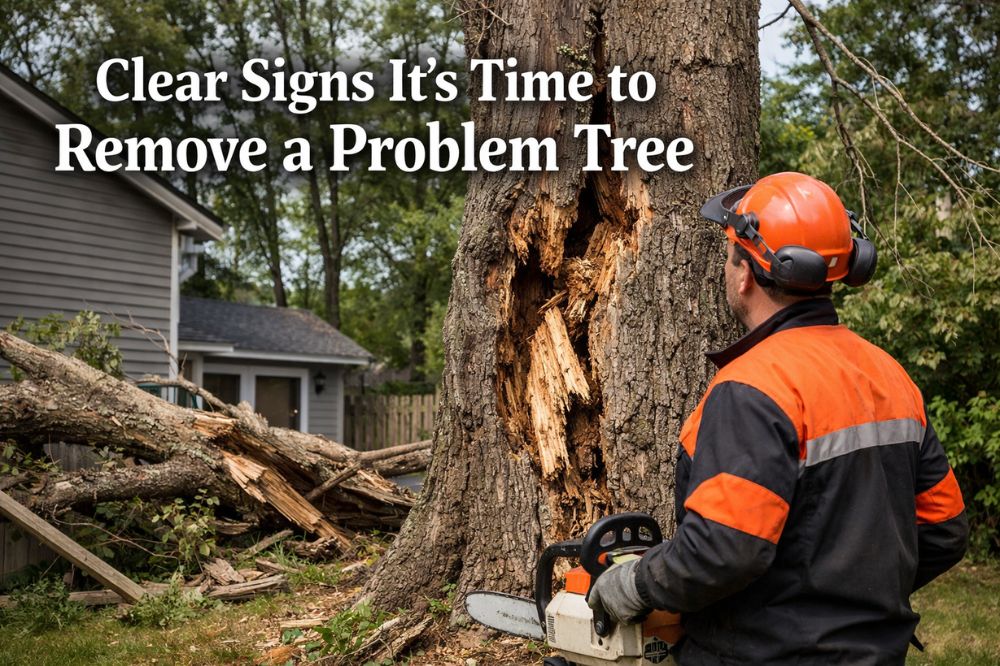
A summer storm rolls through, the wind picks up, and there's a loud crack in the yard. If a tree just came down on your house, your car, or your driveway, you need a clear plan. This guide walks you through storm damage tree removal step by step, from the first minutes of safety to getting a professional crew out. We do emergency tree removal in Atlanta all season long, so we've seen every version of this. Take a breath. Most of it is manageable once you know the order to do things in.
Safety comes first, before anything else
The tree can wait. People cannot. Before you think about cleanup, make sure everyone is safe.
If a tree has crashed through your roof or a wall, get everyone out. Damaged framing can keep shifting, so sit in the car until you know the structure is stable.
Now the big one: power lines. A downed tree often brings lines down with it, and those lines can hide in the branches.
- Treat every line as live. Assume any wire on or near the tree still has power, even if the neighborhood is dark.
- Stay back at least 30 feet. Power can jump, and the ground around a live line can be charged too.
- Call 911 if a line is down, sparking, or on your home.
- Call Georgia Power or your utility to report the line so they can cut power to it.
- Keep kids and pets inside and away from the whole area.
Do not try to move branches off a wire yourself. This is the part of storm cleanup that hurts people every year, and it is completely avoidable.
Document the damage for your insurance claim
Once everyone is safe and the scene is stable, grab your phone. This step matters more than most folks realize. Take photos and video before you move a single branch. Your insurance company wants to see the damage exactly as the storm left it. Clean up first and you can lose part of your claim.
Get wide shots of the whole scene, then close-ups of the damage. Capture the tree on the roof, the dented car, the crushed fence, anything the storm touched. Snap the base too, so it's clear it fell rather than being cut.
Then call your insurance company and open a claim. Ask whether they want an adjuster to see it before removal starts. A good tree crew can also give you a written estimate that helps back up the claim.
Does homeowners insurance cover storm damage tree removal?
Usually, yes, but there's a catch. Most homeowners policies in Georgia cover storm damage tree removal when the tree hits something they insure, like your house, garage, fence, or a car under comprehensive coverage.
Here's where people get surprised. If a tree falls in your yard and hits nothing, many policies won't pay to haul it off, or they cap it at a few hundred dollars. Coverage tends to follow the damaged structure, not the tree.
There are limits and deductibles in play, and every policy is different. Ask your agent point blank what's covered. When you call us for storm damage tree removal, we can work with your paperwork so the claim goes smoothly.
Why you should not touch a storm-damaged tree yourself
A tree that's down or leaning after a storm is not the same as one you plan to cut on a calm day. It's loaded with hidden force, and that's what makes it dangerous.
Think about a big limb bent under the weight of the trunk. It's spring-loaded, holding a huge amount of tension. Cut it in the wrong spot and it whips back fast enough to break bones.
A partly uprooted tree is just as tricky. The root ball may be half out of our Georgia red clay, and the whole trunk can be balanced on the edge of rolling. Leaning and split trunks carry the same risk. A chainsaw here is a bad idea for anyone without training. If you're not sure whether a leaning tree was already weak, our guide on how to tell if your tree is dead or dying helps you spot the warning signs.
How a professional emergency crew handles it safely
This is where the right training and gear change everything. A trained crew reads the tree first, before any cutting starts. We look at where the tension is, which way the trunk wants to move, and what's holding it up.
From there we work in a planned order, releasing that spring-loaded tension in controlled cuts so nothing snaps back. For a tree on a roof or tangled in lines, we use rigging and sometimes a crane to lift sections off instead of dropping them. We coordinate with the utility on any live line, then clear the debris and leave your property safe to walk through again.
Response time and what affects emergency cost
After a big storm, phones ring off the hook across Metro Atlanta, so honest response times can stretch a bit. For true emergencies, a tree on the house or blocking your only way out, we push to get there as fast as we safely can, day or night. Emergency work costs more than a scheduled job. Here's what drives the price:
- Where the tree landed. One on the ground is simpler than one on your roof or wrapped in lines.
- Size and species. A tall Georgia pine or heavy oak takes more work than a small tree.
- Equipment needed. A crane or heavy rigging adds to the total.
- Time of day. Overnight and holiday calls run higher.
- Access. Tight backyards, fences, and slopes make the job harder.
For standard pricing, our Atlanta tree removal page lays out the ranges. Emergency calls sit above those numbers because of the added risk and timing.
Atlanta storms and our tall pines
If you live here, you know the drill. Summer thunderstorm season brings sudden downbursts, and every few years a hurricane's leftover wind and rain pushes up from the Gulf into North Georgia. Counties like Cobb, Fulton, and Cherokee all feel it.
Add in our tall pines with shallow roots in soft, soaked clay, and trees come down more often than folks expect.
If a storm brought a tree down on your property, don't risk it yourself. Call Stanton Tree Service at (470) 914-3402 for fast, safe emergency tree removal in Atlanta, or learn more about our emergency tree removal service. We're a licensed, insured, family-run crew, and we'll give you a free estimate and a straight answer.