Tree work is one of those services where the difference between a good company and a bad one is not obvious from a flyer or a Facebook ad. Bad tree companies exist -- some do not carry insurance, some use undertrained crews, and some quote low and bill high. The consequences can be significant: property damage, injury liability that lands on you, or work done so poorly the tree becomes more dangerous than before.
These seven questions cut through the noise. Ask them before signing anything.
Are you licensed and insured -- and can you provide a certificate of insurance?
This is the most important question. Georgia requires tree companies to carry general liability insurance and workers' compensation. General liability covers damage to your property if something goes wrong. Workers' comp covers the crew if someone is injured on your property.
The critical step: do not just ask if they are insured -- ask them to send you a certificate of insurance. A legitimate company will provide one with no hesitation. If they hedge or say they will bring it when they arrive, walk away. Without verified coverage, any accident on your property could become your financial and legal problem.
Do you have ISA-certified arborists on your team?
The International Society of Arboriculture (ISA) is the recognized professional standard for tree care expertise. ISA certification requires passing a rigorous exam covering tree biology, pruning standards, diagnosis, and safety. It is not required to operate a tree company in Georgia, but it signals that the company invests in actual expertise -- not just equipment.
For routine removal and stump grinding, ISA certification is a quality indicator. For complex work -- hazard tree assessment, disease diagnosis, or pruning a valuable specimen tree -- you want ISA-certified eyes on the job.
Can you give me a written quote before work starts?
Any reputable tree company will provide a written estimate before touching your trees. The written quote should specify exactly what work will be done, what is included (debris removal, stump grinding, cleanup), what is excluded, and the total price. It should also note any conditions that could change the price.
If a company wants to start work and settle the price afterward, stop. Verbal agreements in tree work are a recipe for surprise invoices. Get it in writing, every time.
What does your crew look like for this specific job?
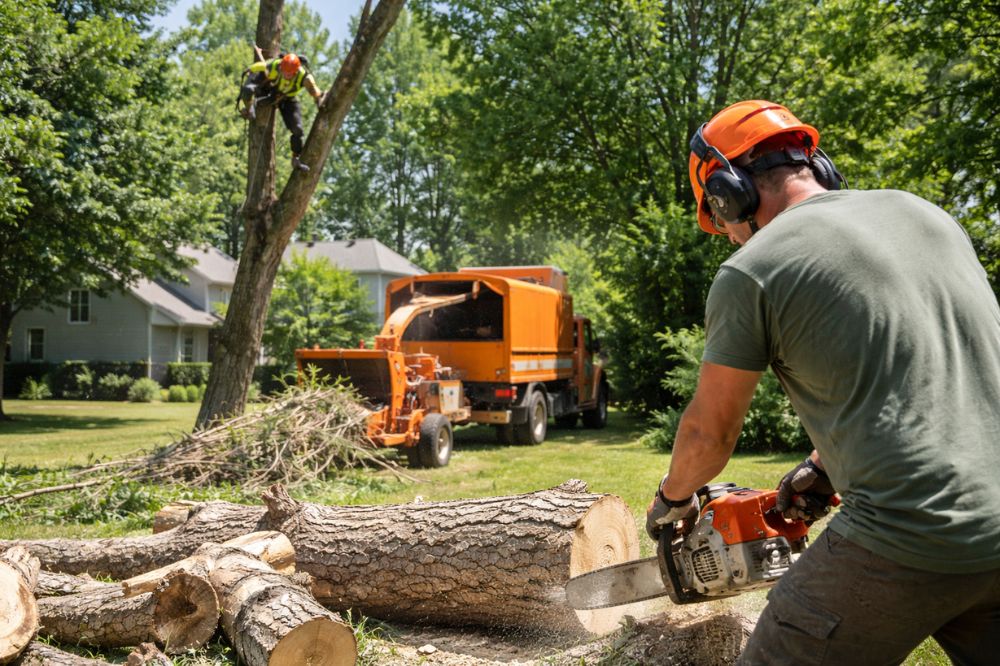
Ask who is actually doing the work. Is the person quoting you the one leading the crew? How many people will be on site? What equipment will they bring? For tree removal, you want to understand whether they are planning to use a bucket truck, a crane, or climbers -- and why.
This question also surfaces subcontracting situations. Some larger companies quote the job and then hand it to a sub they have never worked with. That is not always bad, but you should know. Ask directly: Is your company doing this work, or are you subcontracting it?
How do you handle utility lines near the tree?
Power lines are the most common complication in tree removal across Metro Atlanta. Utility easements run through countless backyards in Cobb, Fulton, Cherokee, and Gwinnett counties -- and trees grow into them constantly. Ask specifically how they handle work near live utility lines.
The answer should include mention of calling 811 before ground disturbance and coordination with Georgia Power or the local utility if line clearance is required. Companies that wave off power line concerns without a clear plan are a liability.
What happens if something is damaged during the job?
Ask this directly. A professional company will answer without hesitation: damage is covered by their liability insurance, they document the job before and after, and they have a clear process for claims. A vague response is less reassuring than: we carry $1M in general liability, here is the certificate. The quality of the answer tells you how seriously the company takes accountability.
Can you provide local references or reviews?
Any established tree service in Metro Atlanta should have a track record you can verify. Check Google reviews specifically -- they are harder to manipulate than Yelp or Facebook. Look at review patterns: consistent praise for showing up on time and leaving the yard clean matters more than a handful of five-star reviews with no detail. Ask for references from nearby properties where you could theoretically drive by and see the work.
Red Flags That Should Make You Walk Away
Door-to-door solicitation after a storm: Storm chasers show up in force after major weather events across Atlanta. They offer discounts for same-day work, often demand cash upfront, and disappear before the job is complete -- or before you realize the work was done dangerously. If someone knocks on your door uninvited offering tree work after a storm, decline and call a local company you have verified independently.
Pressure to decide immediately: Legitimate companies do not use high-pressure sales tactics. If you are told the price is only valid today or that they have one spot left, that is a manipulation tactic. Good tree companies are busy -- they do not need to pressure you.
No physical address or local presence: A company with only a phone number and a Facebook page is harder to hold accountable. Look for a company with a verifiable local address, established online presence, and reviews that go back more than a few months.
Recommending tree topping: Tree topping -- cutting off the main trunk or major limbs to reduce height -- is condemned by virtually every professional arborist organization. It damages trees, creates hazards, and is the calling card of untrained operators. If a company recommends topping as a standard service, they are not following professional standards.
How to Compare Quotes Fairly
Getting 2-3 quotes is standard practice for tree work. But comparing quotes only by price misses the point. Here is how to compare them usefully:
- Make sure the scope matches. One quote may include stump grinding; another may not. One may include debris haul-away; another charges extra. Compare what is actually included, not just the bottom line.
- The lowest quote is not always the best deal. A $200 difference between a verified, insured company and one that cannot produce a certificate of insurance is not a savings -- it is a risk transfer to you.
- Ask each company to walk you through their approach. How will they fell the tree? Where will it drop? The quality of this conversation tells you whether the crew has thought through the job.
About Stanton Tree Service
Stanton Tree Service is locally owned and operated in Metro Atlanta. We serve Cherokee, Cobb, Forsyth, Fulton, Gwinnett, and Paulding counties for tree removal, stump grinding, and tree trimming. We are fully insured, provide written quotes before any work begins, and clean up completely before we leave.
Get a Free Quote from a Company You Can Verify
Stanton Tree Service is locally owned, fully insured, and ready to answer every question on this list -- including providing our certificate of insurance before you book.
Free quotes. Written estimates. (470) 914-3402
Request a Free Estimate