
Most trees are worth keeping. But some become a real hazard, and knowing the signs you need to remove a tree can save your house, your car, or worse. After years of climbing oaks and pines all over Metro Atlanta, we have learned which warning signs mean a tree should come down and which ones just need a little care. Here is how we sort it out.
This post is about the removal decision. If you are trying to figure out whether a tree is alive at all, read our guide on whether your tree is dead or dying. If you think a tree is sick, we cover that in how to tell if your tree is sick.
Big dead sections or a mostly bare canopy
Look up. If a large part of the crown has no leaves while the rest of the tree is full, that dead section is a problem. Those bare limbs are already dying, and they will start dropping.
A little dead wood is normal and easy to prune out. But when a third or more of the canopy is bare, the whole tree is often on its way out. That is one of the clearest signs you need to remove a tree.
A tree that suddenly started leaning
Trees that grew crooked from the start are usually fine. The one to worry about is a tree that was straight and then began to lean.
A sudden lean means the roots are letting go. Check the soil on the side opposite the lean. If you see the ground heaving up, cracking, or roots lifting out of our Georgia red clay, the tree is failing at the base. That tree can come down in the next storm, and it needs a look right away.
Deep cracks or splits in the trunk
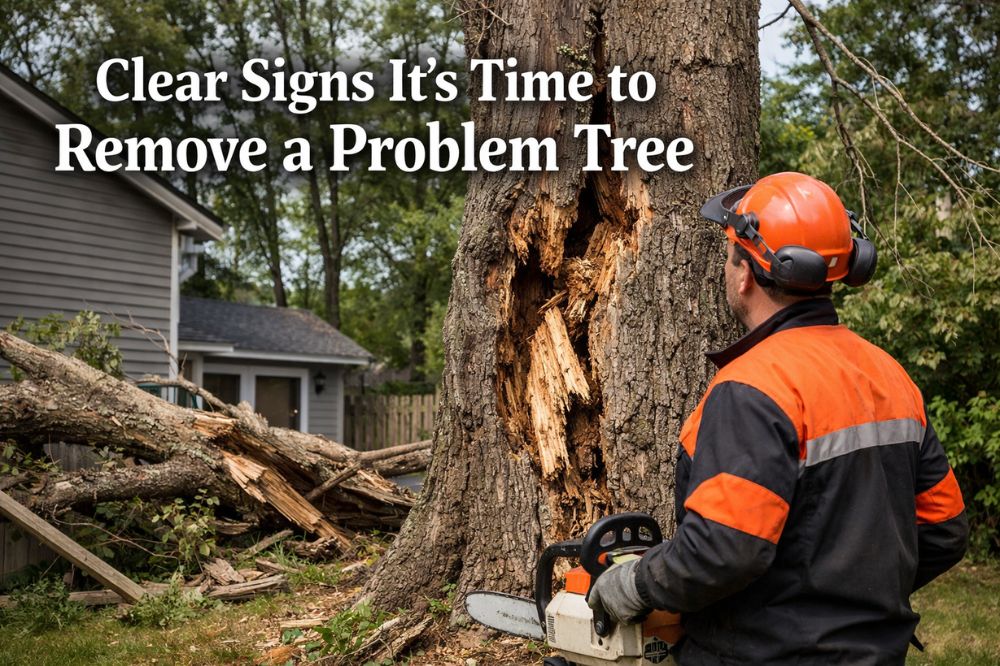
The trunk is the tree's backbone. Deep vertical cracks, a split where two big stems meet, or a seam running up the bark all point to a weak spot.
Trees with a tight V shape between two trunks are especially risky. Bark gets pinched in that joint, the union stays weak, and one of those stems can tear off in high wind. If you can slide a finger into a crack, take it seriously.
Mushrooms, fungus, or a hollow trunk
Mushrooms growing at the base or on the trunk are bad news. They feed on dead wood, so their presence usually means the tree is rotting from the inside.
You cannot always see internal decay, but a few clues give it away:
- Mushrooms or shelf fungus at the base or on the bark
- Soft, punky wood that crumbles when you poke it
- A hollow sound when you knock on the trunk
- Sawdust piles at the base from carpenter ants or borers
A rotting trunk can look solid right up until it snaps. When the core is hollow or soft, removal is almost always the safe call.
Falling limbs, root damage, and trees too close to the house
Some hazards are easier to spot from the ground. A few of these are strong signs you need to remove a tree, or at least get it checked fast.
Big limbs already dropping. If you keep finding large branches on the lawn, the tree is shedding weight it can no longer hold. That is your warning before a bigger limb comes down.
Roots damaging your foundation or driveway. When surface roots start cracking your slab, lifting the driveway, or pushing into the foundation, the tree was planted too close. Cutting those roots to fix the concrete can destabilize the tree, so sometimes the tree has to go.
Storm damage. Our summer thunderstorms and the odd hurricane leftover can strip half a canopy or crack a main stem. A tree that lost a big chunk of its structure may not recover.
Planted too close to the house or power lines. A large tree crowding your roof or tangled in the lines is a standing risk. Trees near power lines are dangerous, and that job belongs to a pro, never a homeowner with a ladder.
Which problems can be fixed, and which mean removal
Not every warning sign is a death sentence. Plenty of trees just need care, not a chainsaw.
Things we can often fix with pruning or treatment include a few dead limbs, minor storm cleanup, light thinning to reduce weight, and some early diseases caught in time. A healthy tree with one bad branch is worth saving.
Removal is usually the answer when the trunk is hollow or badly rotted, the roots have failed and the tree is leaning, most of the canopy is dead, or a main stem has split. In short, if the core structure is compromised, no amount of trimming brings it back.
Some cases sit in the middle, and that is exactly when a trained set of eyes is worth it. Knowing when to remove a tree versus when to treat it is the whole job.
Why a leaning pine near your Atlanta house is urgent
Metro Atlanta is full of tall Georgia pines, and they deserve a special warning. Pines grow straight and shallow rooted in our red clay, so a leaning pine near the house is one of the most urgent signs you need to remove a tree.
Pines do not bend much. When one starts to lean, it tends to fail all at once, roots and all, often during a storm when the ground is soft and the wind is high. A pine that tips toward your roof or bedroom is not something to sleep on.
If a tree is already leaning on your house or hanging over the roof after a storm, do not wait. That is what our emergency tree removal crew is for, day or night.
Get a professional assessment before you decide
Here is our best advice. If you spot any of these warning signs, get a real assessment before you make the call. A tree that looks doomed might be saveable, and one that looks fine might be hollow inside.
Stanton Tree Service is a licensed, insured, family run crew that has worked across Cobb, Fulton, Cherokee, Gwinnett, and Forsyth since 2018. We will walk your property, tell you straight whether the tree needs to go, and never push a removal you do not need. You can learn more about our tree removal services in Atlanta too.
Call us at (470) 914-3402 for a free estimate. We will help you make the safe choice and keep your family and your home protected.