
If you own a home in Metro Atlanta, odds are you've got at least one oak in the yard. They're beautiful, they add real value to a property, and they're the trees we get called about most. Oak tree diseases in Georgia tend to move slowly, so by the time a homeowner notices something is off, the tree has usually been struggling for a year or two. A lot of what people panic about turns out to be minor. A few of these problems are serious, though, and one of them has no cure at all. Here's what we run into in Cobb, Fulton, Cherokee, Gwinnett, and Forsyth yards, and how to tell an oak that needs a little help from one that needs to come down.
First, figure out which oak you have
Most oaks around here fall into two camps. White oaks (white oak, post oak) have rounded leaf lobes. Red oaks (water oak, willow oak, southern red oak) have pointed lobes with bristle tips, and they're the group that tends to go downhill fast.
Water oaks and willow oaks fill older Atlanta neighborhoods, and a lot of them are now 60 or 70 years old. That's about the end of the road for a water oak. One that looks fine from the driveway can be mostly hollow inside.
Leaf spots, blotches, and brown edges
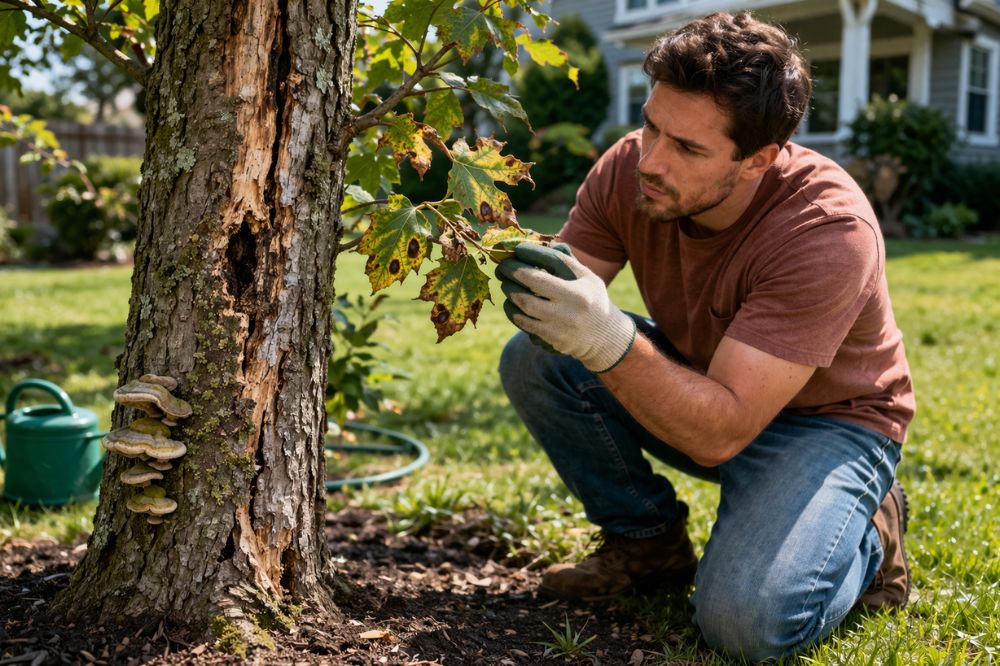
This is the number one call we get in spring. Leaves come out crinkled, with brown or purple blotches, and a bunch of them drop early. Nine times out of ten that's anthracnose or oak leaf blotch, driven by a wet, cool spring. Georgia hands us plenty of those.
Here's what surprises people. A healthy mature oak can lose a big share of its leaves to this and be fine. It pushes a second set in early summer and carries on. No spray, no injection. Rake up the fallen leaves so the spores don't sit under the tree all winter, water it during a dry August, and let it be. Start paying closer attention only if it hits hard three or four years running, or if whole branch tips are dying back instead of leaves just spotting.
Hypoxylon canker, the one we hate to find
If we had to name the worst of the oak tree diseases in Georgia, it's this one. Hypoxylon canker already lives quietly inside a lot of perfectly healthy oaks and does nothing for decades. Then the tree gets stressed (a bad drought, construction damage, roots cut for a driveway or a pool) and the fungus takes over.
What you'll see is bark sloughing off in sheets. Under it there's a crusty layer that starts out silver or tan and turns black, almost like burnt charcoal. The top of the canopy usually thins out around the same time.
There's no cure for it. No spray, no injection, no feeding program brings that tree back. Once hypoxylon is showing on the trunk or a main limb, the wood underneath is already decaying and the tree turns brittle fast. We've taken down oaks where limbs snapped just from the pull of our rigging. A tree like that needs to come off the property before a storm takes it off for you.
Root rot and our red clay
Georgia red clay holds water like a bowl, and oaks want soil that drains. So when a downspout empties right by the trunk, or a new patio changes the grade, or fill dirt gets pushed around during a build, roots sit wet and start to rot. Armillaria (honey fungus) and Phytophthora both do well in those conditions.
Things to look for at ground level:
- Clusters of honey colored mushrooms at the base in fall
- A white fan of fungus under the bark near the soil line
- Black, stringy strands that look like shoestrings in the dirt
- A trunk with no flare at the bottom, going into the ground straight like a telephone pole
That last one usually means the tree got planted too deep or buried under fill, and the roots are slowly suffocating. Root problems are what drop trees in storms, because the canopy can look green and full while the anchor underneath is gone. If mushrooms are popping up around the base, our guide on what mushrooms at the base of a tree mean is worth a read before you decide it's nothing.
Borers, oak wilt, and the rest
Ambrosia beetles and red oak borers go after oaks that are already weak. You'll see tiny, perfectly round holes in the bark, sometimes with toothpick sized strands of sawdust poking out in spring. Borers are almost always a symptom, not the cause. Something stressed that tree first.
Oak wilt gets attention online because it tears through forests in Texas and the Midwest. Of all the oak tree diseases in Georgia, it's the most over-diagnosed, and it's genuinely rare here. If somebody knocks on your door after a storm saying your red oak has oak wilt and needs a $1,800 treatment today, get a second opinion before you write a check.
Which oak tree diseases in Georgia can actually be treated
Be honest about the odds before you spend money on a tree:
- Usually worth treating: leaf spot and anthracnose (mostly by fixing conditions), borers caught early, soil compaction, mild root issues you can solve with drainage and proper mulch.
- Manageable with pruning: a decayed limb or two, deadwood through the canopy, a small cavity. Good pruning buys an old oak years.
- Not treatable: hypoxylon canker, advanced root rot, a mostly hollow trunk, or an oak that has lost more than about half its canopy.
Rough numbers for Metro Atlanta: deadwooding or a crown cleaning on a mature oak usually runs $450 to $1,200 depending on size and access. Taking down a large oak over a house tends to land between $1,200 and $3,500, and a big one needing a crane can go past that. Stump grinding afterward is typically $150 to $400 per stump. Anybody who quotes a firm price without looking at the tree is guessing.
When an oak has to come down
We don't push removal. A mature oak is worth real money in shade and curb appeal, and we'd rather prune it and see you again in three years. But a few things move a tree from watch it to remove it: hypoxylon on the main trunk, a cavity taking up most of the trunk diameter, a new lean with cracked or heaving soil on one side, or major roots cut on the house side.
If you're trying to work out whether your oak has crossed that line, our post on telling a dead tree from a dying one walks through the simple checks. And don't let anybody talk you into topping a struggling oak to save it. Topping makes decay worse, and it turns a tree with a problem into a hazard.
Get a real set of eyes on your oak
Photos on the internet only get you so far. Two oaks with identical spotted leaves can have completely different futures, and the difference usually shows up in the trunk and the root flare, not the canopy. Most oak tree diseases in Georgia move slowly enough that you have time to make a good decision, and the ones that don't are exactly the ones you want caught early.
Stanton Tree Service is a licensed and insured, family run company working across Metro Atlanta. We'll come out, look at your oak, and tell you straight whether it's a nothing problem or a real one. Estimates are free. Call or text (470) 914-3402 and we'll get you on the schedule.