
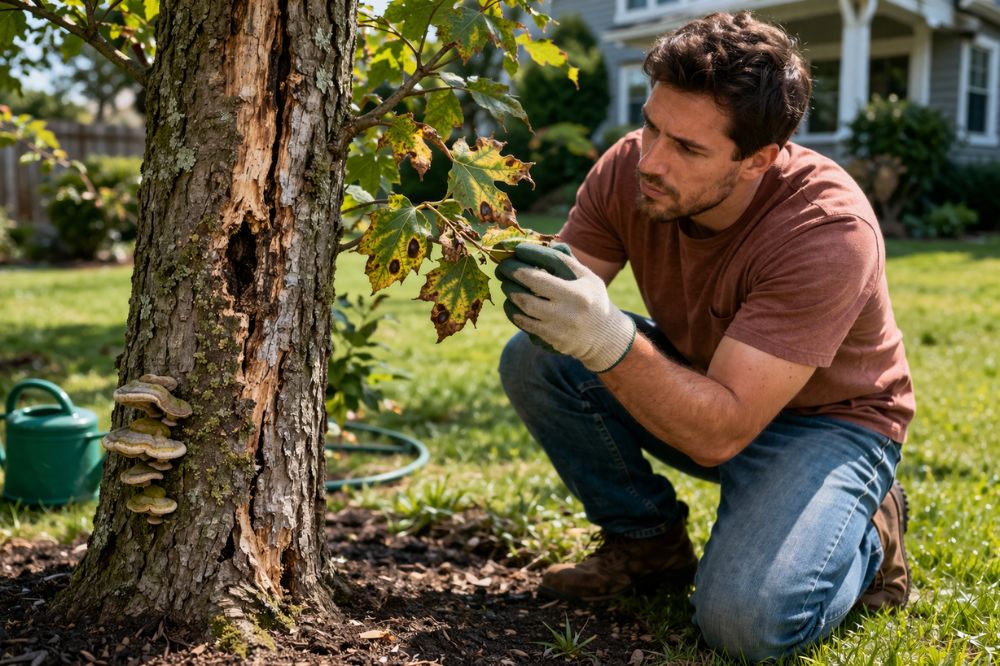
If you've spotted mushrooms at base of tree trunks in your yard, you're right to take a closer look. We get calls about this every year in Metro Atlanta, usually after a warm, wet stretch in late summer. Sometimes those mushrooms are harmless. Sometimes they're the first thing a homeowner notices before a big oak comes down in a storm. The trick is knowing which one you've got.
What Mushrooms at Base of Tree Trunks Are Telling You
A mushroom is the fruit of a fungus, so what you see is small compared to what's happening underground and inside the wood. When one pops up in your lawn or in mulch, the fungus is usually feeding on dead stuff. Old roots, buried scrap wood, leaf litter. That kind is doing your Georgia red clay a favor.
The other kind is the problem. Some fungi feed on living wood, breaking down the heartwood and the root flare, which is the part holding the whole tree up. By the time you see mushrooms at base of tree trunks from one of those, the decay has usually been working for years.
Here's the simple rule we use. Where the mushroom grows matters more than what it looks like. Mushrooms out in the open lawn, several feet from the trunk, are usually fine. Mushrooms coming right out of the bark, or packed tight against the root flare, are a warning.
The Fungi We Worry About Around Metro Atlanta
Hard shelves and conks on the trunk
These are the woody, half circle brackets that stick out of the bark. Ganoderma is the common one here, and we see it on mature oaks all over Fulton and Cobb. Find one on the lower trunk and you're looking at internal decay. Conks don't grow on solid, healthy wood.
Honey colored clusters at the root flare
Armillaria, what folks call shoestring root rot, comes up as clumps of tan mushrooms hugging the base after fall rains. Pull back some loose bark near the soil line and you may find white fan shaped growth, or black strands that look like shoelaces. Armillaria kills roots. Oaks and pines across Cherokee, Gwinnett, and Forsyth get hit with it, especially trees stressed by construction or drought a few years back.
Bright orange or yellow shelves
Laetiporus, the one people call chicken of the woods, is easy to spot on older oaks. It photographs beautifully. It also means the heartwood is already soft.
Mushrooms That Usually Aren't a Problem
Not every case of mushrooms at base of tree growth means trouble. Here's what we tell people not to lose sleep over:
- Small mushrooms scattered through the lawn, well away from any trunk.
- Mushrooms in fresh mulch or pine straw. They're eating the mulch, not the tree.
- Mushrooms over an old stump or buried roots. That's common after stump grinding, since leftover chips keep breaking down.
How to Check the Tree Yourself
You don't need special tools. If you've got mushrooms at base of tree trunks in the yard, walk out and look at these:
- The root flare. It should widen where it meets the soil. A trunk that goes straight into the ground like a telephone pole usually means soil or mulch is piled too high.
- Soft bark. Press a screwdriver into the trunk near the base. If it sinks in with almost no effort, that wood is punky.
- Cavities and seams. An open hole or a long vertical crack near the fungus is a bad combination.
- The canopy. Thin growth up top, dead limbs, or leaves that came out small and pale this spring point to roots that aren't doing their job.
- Lean. A new lean, or soil lifting on one side of the base, means roots are letting go. Treat that as urgent.
If a couple of those show up along with fungus at the base, the tree needs trained eyes on it. Our guide on how to tell if your tree is sick covers more warning signs, and a leaning tree has its own rules.
Can a Tree With Fungus at the Base Be Saved?
Honest answer: usually not, once decay reaches the root flare. Wood doesn't heal. A tree seals damage off and grows around it, but rotted wood stays rotted. There's no spray or injection that reverses it, and anybody selling you one is selling you nothing.
What you can do is quit making it worse.
- Pull mulch back off the trunk. Mulch piled against bark holds moisture there and invites rot.
- Keep mowers and string trimmers away from the base. Every nick in the bark is a door for fungus.
- Fix soggy spots. Our clay holds water, and roots that sit wet get weak.
- In a dry summer, water deeply once a week instead of sprinkling every day.
Knocking the mushrooms down doesn't cure anything, since the fungus lives in the wood. Do it anyway if you've got kids or dogs in the yard, because some kinds are toxic if eaten.
When the Tree Needs to Come Down
We recommend removal once decay has taken enough of the base that the tree can't hold itself up in a storm. What pushes us that direction:
- Conks growing out of the trunk itself, rather than out of the soil nearby.
- A hollow or soft pocket covering more than about a third of the trunk width.
- Dead wood through the upper canopy on top of fungus at the base.
- A target underneath. A house, a driveway, a power line, or the spot where everybody sits on Saturday.
Location drives a lot of this. A decayed pine in the back corner of five acres in Cherokee County can often stay put. That same pine twenty feet off a Marietta bedroom is a different call. If you're torn, our post on whether a tree is dead or dying helps sort it out.
What It Costs Around Atlanta
Price comes down to size and access more than anything. Most residential removals here land between $400 and $1,500. A small tree under 25 feet often runs $150 to $400, while a large oak or pine in the 50 to 80 foot range runs $900 to $1,500. A big hazard tree tight against a house can go past $2,000. Grinding the stump afterward runs $75 to $600 depending on diameter, and it's cheaper bundled with the removal. There's more detail on our stump grinding and removal services page.
One more thing. After a decayed tree comes out, mushrooms may keep showing up in that spot for a year or two while the leftover roots break down. That's normal, and it isn't a new problem.
Get a Free Look From a Local Crew
Mushrooms at the base of a tree aren't always bad news, but they're never worth ignoring. If you've got fungus on a trunk you'd hate to lose, we'll come out and tell you straight what we see. Stanton Tree Service is a family run outfit, licensed and insured, working all over Metro Atlanta. Call (470) 914-3402 for a free estimate. No charge to look, and no pressure either way.