
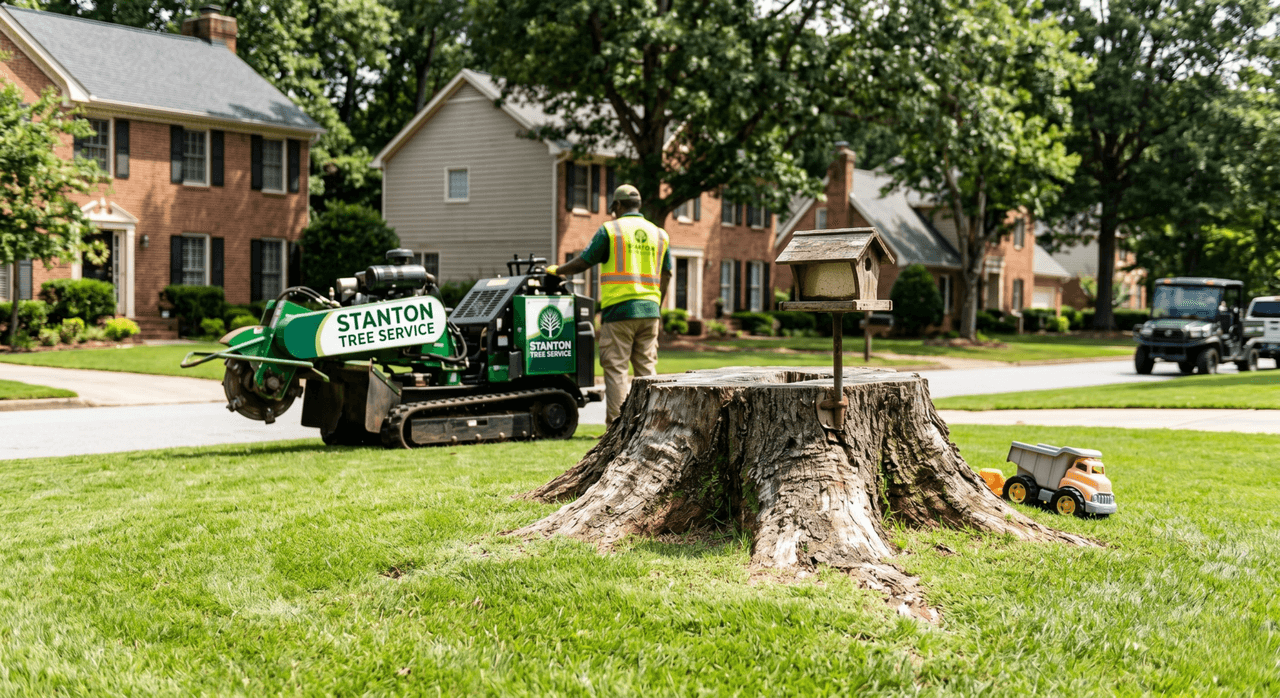
You had a tree taken down, and now there's a stump sitting in the yard reminding you of it every day. Stump grinding in Atlanta is the fastest, cleanest way to get rid of it. A machine grinds the stump down into chips a few inches below the ground, and the spot is ready to plant grass or landscape over. This guide covers what really happens, what it costs, and whether you should tackle it yourself.
We grind stumps all over Metro Atlanta, from Cobb and Cherokee to Fulton and Gwinnett. Here's the honest rundown.
What stump grinding actually is
Stump grinding uses a machine with a spinning steel wheel covered in sharp teeth. The wheel chews the stump into small wood chips, working from the top down and side to side until the whole thing is below grade.
The roots stay in the ground. They're not dug out. Over the next few years they slowly rot away on their own. What you're left with the same day is a pile of chips and a shallow dip where the stump used to be.
That's the key thing to understand about stump grinding removal in Atlanta. It gets rid of the visible stump fast without tearing your whole yard apart to pull out roots.
Why homeowners get their stumps ground down
A leftover stump isn't just an eyesore. It causes real headaches around the yard.
- Termites and pests. A rotting stump is a buffet for termites, carpenter ants, and beetles. You don't want that colony sitting a few feet from your house.
- New sprouts. Plenty of Atlanta trees, especially sweetgum and some oaks, send up fresh shoots from the old stump and roots and keep trying to grow back.
- Tripping hazard. A low stump hidden in the grass is easy to catch a foot on, and rough on anyone with kids running around.
- Mowing headaches. You have to steer around it every single week, and clipping it with the mower blade is a good way to damage the deck.
- Wasted space. Grind it out and you free up room to plant a new tree, put in a garden bed, or just have clean lawn again.
Grinding versus full stump removal
People mix these two up all the time, so here's the difference.
Grinding shaves the stump down into chips and leaves the roots underground to break down naturally. It's quick, it's less mess, and it costs less.
Full stump removal digs the entire stump and root ball out of the ground. You end up with a big hole and a much bigger disturbance to the yard. It usually needs heavier equipment, and it costs more.
For most Atlanta homes, grinding is the right call. Full removal makes sense when you're pouring a foundation or need that ground completely clear of roots. If you're stuck deciding, our guide on stump grinding vs stump removal lays out which fits your situation.
How the process works and how deep we grind
The job itself is pretty simple once the crew is on site. We clear any rocks or debris around the base, then position the grinder over the stump. The wheel drops down, and we work it back and forth across the wood until it's chewed below the surface.
Standard grinding goes about 4 to 6 inches below ground level. That's plenty if you plan to put down grass seed or sod over the spot.
If you want to plant a new tree there or pour concrete, we grind deeper, usually 8 to 12 inches or more. Deeper takes longer, but it clears the room those projects need. Want a fuller breakdown of timing? See how long stump grinding takes for real time ranges by stump size.
What affects the price of stump grinding in Atlanta
There's no flat rate that fits every stump. A few things move the price up or down.
- Diameter. The wider the stump, the more wood to grind. Size is the single biggest factor.
- Root spread. Some trees send big surface roots out in every direction. Grinding those out too adds work.
- Hardwood vs pine. Atlanta has a ton of dense oak and stringy pine. Oak is slow and tough to grind. Pine gets gummy with sap. Both take longer than soft, rotted wood.
- Access. The grinder has to physically reach the stump. A narrow gate, a steep slope, or a fenced backyard means a smaller machine and more time.
- Red clay and rocks. Georgia red clay is packed hard and hides rocks that dull the teeth fast. A rocky stump can take twice as long.
As a rough guide, a single small stump often runs in the low hundreds, while a large old hardwood or a yard full of stumps costs more. The best number comes from someone actually looking at it.
What happens to the chips and the hole
Grinding makes more chips than most folks expect, usually a good-sized mound right over the spot. You've got two options.
Many homeowners leave the chips in place to settle and use them as free mulch around beds and trees. The other option is hauling them off so the area is clean and level. Tell your crew which you want up front so they can plan the cleanup.
The leftover hole is shallow. Fill it with topsoil, tamp it down, and seed or sod right over it.
DIY versus hiring a pro
You can rent a stump grinder from a hardware store for a day. For one small, soft stump in easy-to-reach ground, that might work fine.
The catch is these machines are heavy, loud, and throw wood and rock at high speed. They're genuinely dangerous if you haven't run one before. Add in our hard red clay and hidden rocks, and a rental can turn a Saturday into a fight.
A pro crew brings the right size machine, grinds to the depth you need, and clears the mess in a fraction of the time. For anything big, near a fence or foundation, or more than one stump, hiring out is usually the smarter money. You can see everything we handle on our stump grinding and removal services page.
Ready to lose that stump?
Every stump is a little different, so the surest way to get a real price is to have someone take a look. Size, wood type, root spread, and access all shape the job.
Want a straight answer and a free estimate on stump grinding in Atlanta? Call Stanton Tree Service at (470) 914-3402. We'll tell you exactly what to expect before any work starts.