
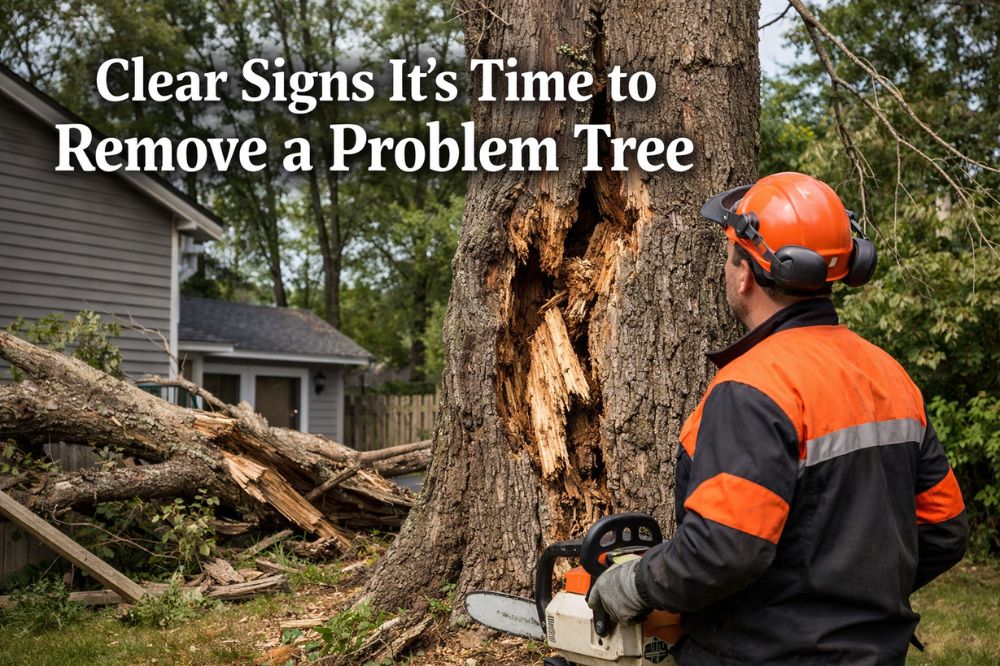
A storm rolls through Cobb County at two in the morning, and by sunrise there is a long strip of bark blown off the oak out front. A tree struck by lightning can look almost normal from the street and still be wrecked inside. We get these calls all summer across Metro Atlanta, and we tell folks the same thing. Stay back from it, and do not assume it is fine just because it is still standing.
What Happens When Lightning Hits a Tree
Lightning follows water, and a tree is full of it. When a bolt hits the crown, the charge runs down the damp layer right under the bark. That water flashes to steam in a fraction of a second, and the steam blows the bark outward in a strip that sometimes runs from the top branches into the root flare.
The damage you cannot see matters more. The thin living layer under the bark, called the cambium, moves water up and sugar down. Lightning cooks it. A tree can lose that layer along one whole side and still hold green leaves for weeks, living off water already in the system. Then a hot dry July arrives and the crown browns out at once.
How to Tell If a Tree Was Struck by Lightning
Most strikes leave a mark if you know where to look. Here is what we check:
- A bark strip down the trunk. Usually one to six inches wide, running vertically, sometimes spiraling like a stripe on a candy cane.
- Splintered wood. The edges look shredded rather than cut.
- Scorch marks around the wound, though plenty of strikes leave no burn at all.
- Debris across the yard. Bark chunks thrown 30 or 40 feet often get spotted before the wound.
- A split or crack in the trunk. The worst sign, since the force went through the wood instead of along the surface.
- Sap bleeding from the trunk days later, or sudden wilting on one side of the crown.
Walk the whole tree, not just the side facing your house, and check the ground too. Roots can cook underground with nothing showing up top, and in Georgia red clay you may see a line of cracked soil or dead grass running out from the base. Our guide on telling a dead tree from a stressed one covers the other warning signs.
Why Lightning Picks the Trees It Does
Height is the biggest factor, and Metro Atlanta has plenty of it. Loblolly pines in Cherokee and Forsyth routinely hit 90 or 100 feet. Lightning finds the tallest thing in open ground, so a lone pine over your roofline is a far bigger target than the same pine buried in woods. Species matters too. Oaks, pines and poplars take more hits than beech or birch, largely because smooth bark channels rainwater down the outside and gives the charge an easier path along the surface. You cannot shrink a 100 foot pine, but you can cut the odds of losing it, and our guide on storm proofing your trees covers what to do before the season starts.
Can a Tree Survive a Lightning Strike?
Plenty do. A strike that clips one side, peels a narrow bark strip and leaves the root flare alone is survivable, especially on a healthy mature oak. Those trees usually wall the wound off and keep going for decades with a visible scar.
What kills a tree is damage that wraps the trunk, splits it, or reaches the roots. Once more than about half the circumference loses its cambium, the odds drop fast. Pines are the hard case, because the fresh wound pulls in bark beetles within weeks. We watch that play out every summer in Gwinnett and north Fulton.
Unless the tree is an obvious hazard, give it a full growing season and see what leafs out. Water it during dry spells and prune deadwood only. Skip the fertilizer, and do not paint the wound with tar or sealer, which traps moisture and worsens the rot.
What to Do in the First 48 Hours
- Keep everyone away. A damaged tree can drop limbs days later. Rope off a circle about one and a half times the height of the tree.
- Look up for power lines. If any part of the tree touches a line, call Georgia Power and stay clear until it is handled.
- Take photos before you clean up, since adjusters want to see the tree where it landed.
- Do not start cutting. Split trunks and hung up limbs hold tension you cannot see from the ground, and that is how people get hurt.
- Get an inspection. A licensed, insured crew can tell you in 20 minutes whether you have a watch and wait tree or a hazard.
When a Tree Struck by Lightning Has to Come Down
Some of these are judgment calls. Others are not. We recommend removal when we see any of these:
- The bolt split the trunk, or there is a crack you can slide a finger into.
- More than half the bark is gone around the circumference.
- Major roots or the root flare got cooked, which often shows up as a new lean.
- The tree leans toward a house, a driveway, or anywhere people spend time.
- Large dead limbs hang over a roof or a play area.
- It is a pine with fine sawdust or popcorn sized pitch tubes, meaning beetles already moved in.
A damaged tree sitting over your roof is not a next month problem. Storm damage tree removal needs doing before the next round of weather pushes it over.
What It Costs in Metro Atlanta
Our inspections are free. If the tree has to go, removing a large pine generally runs $800 to $2,500 depending on height and access. An oak close to a house tends to land between $1,200 and $3,500, and crane work on a tight lot can push past $4,000. Pruning damaged limbs instead of a full removal runs $350 to $900, and stump grinding adds roughly $100 to $400.
A lightning strike is a covered peril on nearly every Georgia homeowners policy, but most only pay for removal if the tree damaged a covered structure like your house, garage, fence, or car. A struck tree standing in the yard, hurting nothing, is usually your bill. Call your agent anyway, since some policies carry a small debris allowance. We go deeper on whether homeowners insurance covers tree removal.
Frequently Asked Questions
Will a tree struck by lightning die?
Not necessarily. A good share survive, especially hardwoods that take a glancing hit on one side. Trees with a split trunk, damage wrapping more than half the circumference, or cooked roots usually do not. Pines are likeliest to die, often from the beetles that follow rather than the strike itself.
How long does it take for lightning damage to show up?
The wound shows immediately, but the verdict takes longer. Some trees decline within two or three weeks. Others hold on, then collapse during the first hot dry stretch of the next summer. That is why arborists want a full season before calling it.
Can a pine tree survive a lightning strike?
Sometimes, but pines have the worst odds of any tree we work on around Atlanta. Even one that holds green needles all summer often dies the next year once bark beetles find the wound. Fine sawdust or small pitch tubes on the trunk mean it is already losing.
Get Someone to Look at It
If you have a tree struck by lightning anywhere in Cobb, Fulton, Cherokee, Gwinnett or Forsyth, we will come out and tell you straight whether it can stay. No charge for the estimate, and no pressure to take down a tree that does not need to go. Stanton Tree Service is a licensed and insured family run crew that has cleaned up after Georgia storms for years. Call or text (470) 914-3402 for a free estimate.