
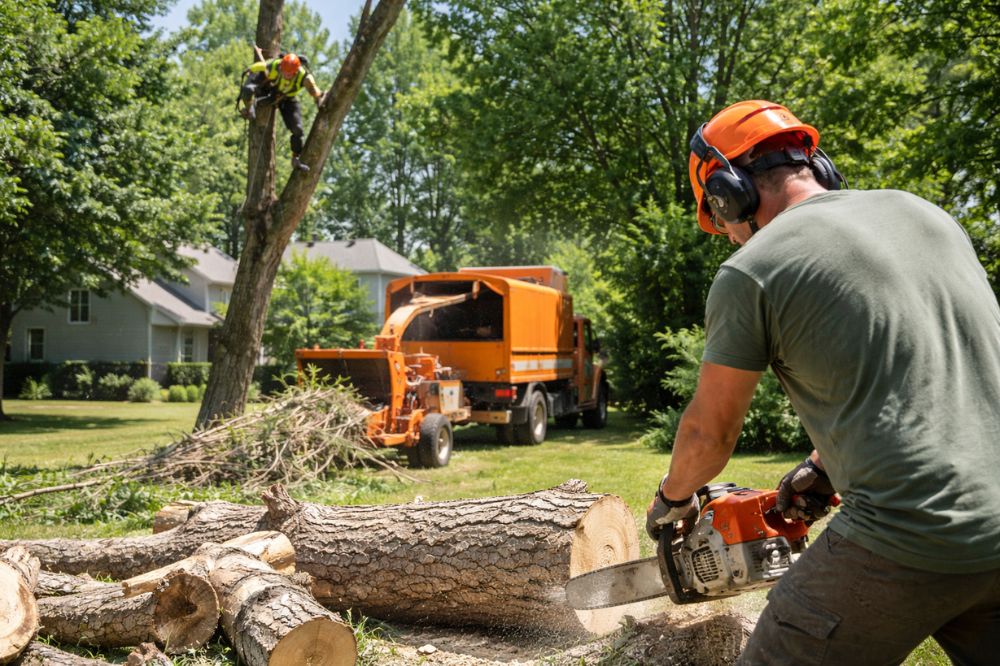
A dead pine tree in a Metro Atlanta yard is not a problem you can sit on for long. Pines are all over Cobb, Cherokee, Gwinnett and Forsyth, loblollies mostly, and they're the one tree we watch go from looking a little thin to genuinely dangerous inside a single season. If the needles on yours turned brown and stayed brown, there's a good chance the tree is already gone.
Here's how to read what you're looking at, what probably killed it, and how fast it needs to come out.
What does a dying pine tree look like?
Pines don't give you much warning. An oak can limp along half dead for years and still leaf out every spring. A pine usually tells you over a few months, and by then the decision has mostly been made for you. These are the symptoms we see most often on Georgia pines:
- Needles going yellow, then rusty brown. It usually starts at the top of the tree and works down.
- Heavy needle drop outside the normal fall shed, enough to carpet the ground under the tree.
- Pitch tubes on the trunk. Little popcorn-looking blobs of sap, often with a hole in the middle. That's the tree trying to push beetles back out.
- Sawdust in the bark crevices or piled at the base. Arborists call it frass. It means something is boring inside the wood.
- Round exit holes about the size of a pencil lead, scattered across the bark.
- Bark plates sliding off and leaving smooth, pale wood underneath.
- Woodpeckers working the trunk hard. They're after the beetles, which means the beetles are already in there.
- A bare top while the lower limbs still hold green needles.
Dead lower branches are usually normal
If the bottom third of your pine has bare, brittle limbs but the crown up top is full and green, relax. Pines shade out their own lower branches as they grow tall. That's self-pruning, not decline. It's the top of the tree you want to watch. A pine dies from the top down.
Is a pine tree dead when it turns brown?
If the whole crown is brown, yes, almost always. That catches people off guard, because a browned-out oak can push fresh leaves the next spring and be fine. Pines don't work that way. A pine needle that dies doesn't come back, and a pine branch that loses all its needles won't regrow them. The tree has no reserve buds waiting to open. Once the full canopy has gone brown, you have a dead pine tree on your hands, not a sick one.
Partial browning is a different story. Interior needles browning and dropping in October is just normal needle shed. One brown branch on an otherwise green tree might be a single beetle strike or a limb that got damaged. That's worth a look, but it isn't a death sentence.
What causes pine trees to die in Georgia?
Around here it's usually one of these, and often two of them stacked up:
- Pine beetles. Southern pine beetle and Ips engraver beetles go after trees that are already stressed. Once they're established, a mature pine can be dead in four to eight weeks. There's no spray that saves it at that point.
- Drought, then flood. Georgia red clay drains poorly. A dry summer stresses the roots, then a stretch of heavy rain leaves them sitting in water. Pines hate both.
- Root damage from construction. New driveway, a trench for a water line, grading for an addition. Pine roots are shallow and spread wide, so work 15 feet from the trunk can still cut the roots that tree was living on. The decline often shows up a year or two later.
- Lightning. Pines are often the tallest thing on a lot, and they take a lot of hits in Georgia summers.
- Storm damage. A pine that snapped its top in a wind event rarely recovers.
If you want to run through the early warning signs before a tree gets this far, our post on how to tell if your tree is sick walks through what to check.
Can a dead pine tree come back to life?
No. If every needle is brown and brittle and the bark is loose, the tree is finished, and no amount of watering or deep root feeding will change that.
A pine with real green left in the crown is a different conversation. Sometimes a stressed one pulls through if you fix what's bothering it, usually water and soil. But if beetles are already in the trunk, even a partly green pine is on a short clock, and leaving it there puts the pines around it at risk. Beetles spread to neighbors.
How long will a dead pine stand before it falls?
Longer than you'd like, and that's exactly the problem. A dead pine tree can stay upright for two to five years. People see it standing through a few storms and decide it must be stable.
It isn't. Pine wood rots fast in Georgia humidity, and the roots go first, usually within a year or two of the tree dying. The trunk can look solid while the anchor underneath it is mush. Then one soaked spring evening with a 40 mph gust, the whole thing tips over at the root plate.
Dead pines also shed limbs with no warning at all, on calm days. If the tree is anywhere near your roof, a driveway, a deck or a power line, treat it as urgent. Our guide on protecting trees before storm season covers what to deal with first.
What does dead pine tree removal cost in Metro Atlanta?
Pricing follows height and access more than anything else. For Metro Atlanta, here's what homeowners typically pay:
- Small pine under 25 feet: $150 to $400
- 25 to 50 feet: $400 to $900
- 50 to 80 feet: $900 to $1,500
- 80 feet and up, or leaning over the house: $1,500 to $3,000 and sometimes more
Most mature loblollies in Metro Atlanta land in that 60 to 100 foot range, so plan on the upper half of the chart. Our full Atlanta tree removal cost guide breaks down every factor behind those numbers.
One thing worth knowing: a dead pine often costs more than a live one of the same size. Dead wood is brittle and unpredictable, so a climber can't safely work the spar. That means a bucket truck or a crane, which adds to the day. Waiting doesn't save you money either, because the longer it stands, the more equipment the job needs.
The stump is usually quoted separately, somewhere from $75 for a small one up to $600 for a wide pine with a big root flare. You can read how that's figured in our stump grinding and removal services.
Not sure what you're looking at? We'll tell you straight
Plenty of the pines we get called about are fine, and we say so. Others have been dead for two winters and the homeowner had no idea how close to falling they were. Either way, you want to know which one you've got before storm season tests it.
Stanton Tree Service is family run, licensed and insured, and we work across Metro Atlanta. Call (470) 914-3402 for a free estimate. We'll look at your pine and tell you honestly whether it can stay, with a real number if it can't.