
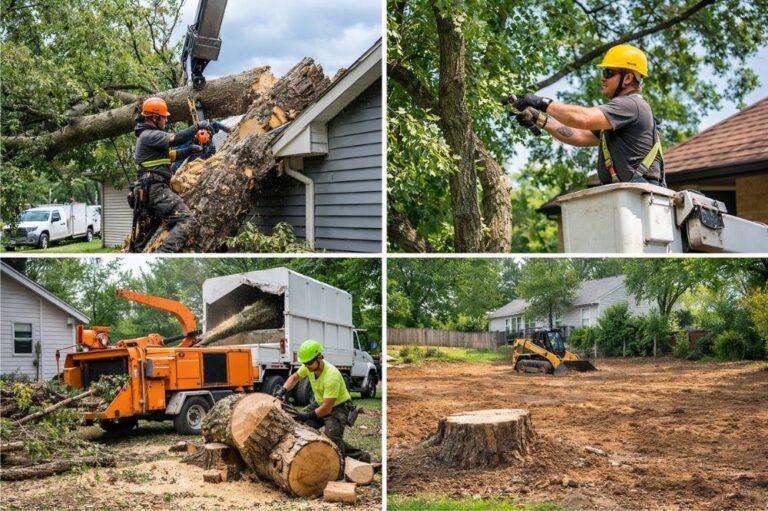
Every storm season in metro Atlanta ends the same way for somebody. A loblolly pine is lying across the backyard, or worse, across the roof, and the first question is what storm tree removal is going to cost and whether insurance will pay for any of it. This post gives you the real price bands we quote, why storm work costs more than a scheduled job, how the insurance split usually lands, and how to avoid the crews that knock on doors after every ice storm.
Why storm tree removal costs more than a scheduled job
A planned removal is a tree standing in one piece, cut on a dry day, in whatever order the crew likes. A downed tree after a storm is the opposite. The wood is under tension, half the root plate may be sticking out of the red clay, and the trunk is often resting on something that cannot take any more weight.
Crews are stretched too. After a big wind event, every tree company in Cobb, Fulton, Cherokee and Gwinnett has a full voicemail by 7 a.m. Night and weekend call-outs mean overtime, and that gets passed along. The risk is higher as well. Cutting a loaded trunk off a roof is slower and more careful than dropping a standing tree, and a crane or a lift is often the only safe way to do it. Expect a storm job to run 25 to 50 percent above what the same tree would have cost on a calm Tuesday in October.
If the tree is only leaning, or a cracked limb is hanging, you may not be in emergency territory at all. Our storm damage tree removal in Atlanta page explains how we sort calls on a storm day. Nothing on a structure and nothing blocking a road usually means we can schedule it at a regular rate later in the week.
Downed tree removal cost in metro Atlanta: the price bands
These are the ranges we see on real storm jobs across the north side, from Marietta to Johns Creek. The big variable is not the tree. It is what the tree landed on.
- Small tree or large limbs on open ground, cut up and hauled: $300 to $800
- Mid-size tree (30 to 60 ft) on the ground in the yard, hauled: $800 to $1,800
- Large oak or pine (60 ft and up) on the ground, hauled: $1,500 to $3,000
- Tree on a fence, shed, deck or car: $1,200 to $3,500
- Tree on the house or roof, rigged off in pieces: $2,500 to $6,000
- Crane or large lift needed for a tree on a structure: add $1,500 to $3,500 for the day
- After-hours or same-night emergency call-out: add 25 to 50 percent
- Stump grinding once the tree is gone: $150 to $450 per stump
Hauling is the line people forget. A 70 ft water oak makes a chipper truck load and a half of brush plus several thousand pounds of log. If you want to keep the wood for firewood and we only cut and stack, the price drops, sometimes by a few hundred dollars. Ask for it as a separate line on the quote.
A tree on the ground versus a tree on the house
This is the split that matters most, for the bill and for insurance. A tree on the ground is a cleanup job. We cut it into pieces we can move and chip the brush. The logs get hauled or stacked. On a clear lot with truck access it is a few hours of work.
A tree on a structure is a rigging job. Nobody can simply cut the trunk, because the roof is holding part of the weight and the rest will shift the moment a cut is made. We tie off sections, lift them clear with a crane or lower them on ropes, and work from the top down. A tree across a roof in Sandy Springs, with a crane, is a most-of-the-day job and usually lands around $4,500 to $5,000. The same oak lying in the side yard is closer to $1,600.
The one job you should never try yourself is a trunk resting on a car or a roof. A loaded log can roll or spring the second it is cut. Our storm damage guide walks through what to do in the first hour, and step one is to stay out from under it.
Who pays for a fallen tree after a storm?
Georgia follows the same rule most states do. A healthy tree that comes down in a storm is an act of nature, and the person whose property it lands on files the claim. Where the tree grew does not decide who pays. Here is how it usually shakes out.
- Your tree falls on your house: your homeowners policy pays for the repair and for getting the tree off the structure, minus your deductible.
- Your tree falls in your yard and hits nothing: cleanup is on you. Most policies do not pay for a tree that only flattened your lawn, though some pay a small amount if it blocks your driveway. Ask.
- Your neighbor's tree falls on your house: your policy pays, not theirs, unless the tree was visibly dead and they had been told in writing and did nothing.
- Your tree falls on your neighbor's house: their policy, by the same rule.
- A tree falls on power lines: the utility clears the line, and the rest of the tree belongs to the property owner.
Policies also cap tree debris removal, often at $500 to $1,000 per tree with a limit per storm. Getting the tree off the house is usually treated as part of the repair rather than debris, but read your declarations page or ask your agent before you sign anything. Our post on whether homeowners insurance covers tree removal goes deeper on the fine print.
What we do on a storm tree removal claim: photograph everything before a single cut, write an itemized invoice that splits "removal from structure" from "cleanup and haul", note the time we arrived, and hand you our certificate of insurance. Adjusters want all of it. Some will let us bill them directly, which saves you fronting the money.
How to avoid the door-knockers after a Georgia storm
Within hours of a big storm, trucks with out-of-state plates start working the neighborhoods that got hit. Some are fine. Many are not. After Helene came through in September 2024 the same pattern played out across Roswell and Dunwoody: a crew cuts the easy part off the roof for cash, leaves the trunk in the yard, and never comes back.
A few habits keep you out of that spot. Ask for a certificate of insurance with your name on it. A real company's agent can email it in minutes. Get the storm tree removal price in writing, with the haul line and the stump line spelled out. Never pay in full up front. A deposit toward a crane rental is normal, the whole job is not. And if the pitch includes "we can waive your deductible", walk away. That is insurance fraud, and it lands on you, not them.
Our honest advice: if the tree is on the ground and not touching anything, you have time. Take photos and call your agent, then get two written quotes. If it is on the roof, call a licensed tree removal crew first and your insurer second, because a tarp goes on faster once the weight is off.
Frequently asked questions
How much does it cost to remove a fallen tree?
In metro Atlanta, a fallen tree on open ground runs about $300 to $3,000 depending on size, and a tree on a house runs $2,500 to $6,000 or more when a crane is needed. Hauling, stump grinding and after-hours call-outs are added on top.
Does homeowners insurance cover tree removal after a storm?
Usually yes, if the tree damaged a covered structure like your house or garage. If it only fell in the yard, most policies do not pay for cleanup, though some cover a tree that blocks the driveway.
Who is responsible for fallen tree removal when it is a neighbor's tree?
In Georgia, whoever owns the property it landed on handles the removal and files the claim. The exception is a tree that was obviously dead and whose owner had been warned in writing.
Can a storm-damaged tree be saved?
Sometimes. A tree that lost one big limb or took a lightning strike can often be pruned and watched. A tree that is uprooted or split down the trunk is done. Our guide on protecting trees from storms covers what to do before the next one.
Get a free storm tree removal estimate
If a tree came down on your place, call Stanton Tree Service at (470) 914-3402. We are a licensed and insured family crew, we answer the phone on storm days, and the estimate is free. Text us a few photos and we can usually give you a range before the truck rolls.