
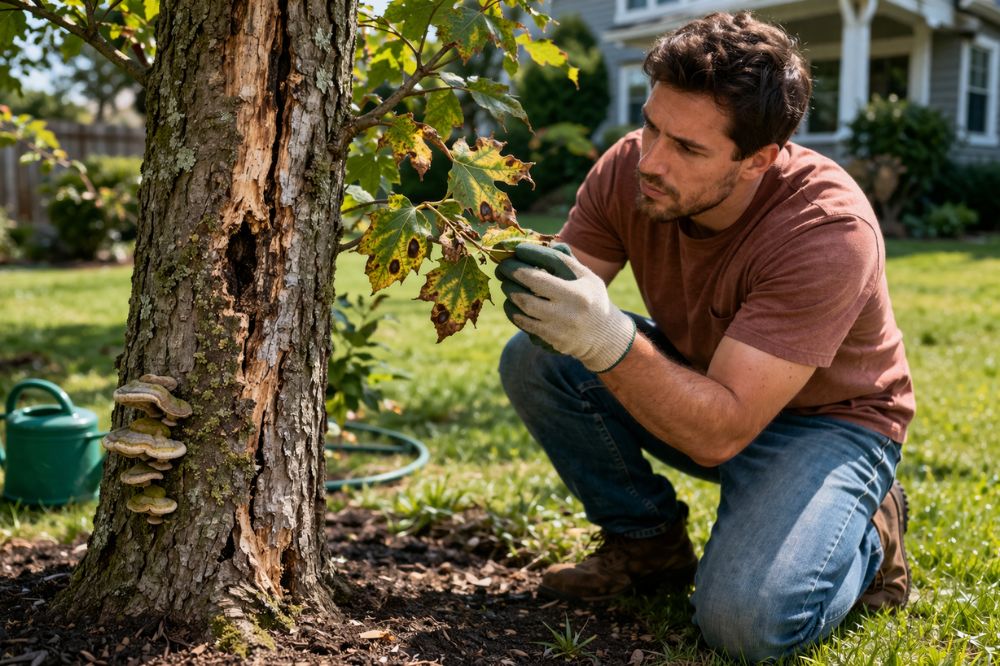
If you have got a tree root cracking your sidewalk or pushing into a flower bed, you are probably wondering: will cutting tree roots kill the tree? It is a fair question, and the honest answer is "it depends." Cut the wrong root, or cut too much at once, and you can hurt a healthy oak or pine. Cut the right ones the right way, and the tree barely notices. We get this question a lot around Metro Atlanta, where big shade trees and dense Georgia red clay mean roots spread wide instead of digging deep.
Will cutting tree roots kill the tree? The short version
Most trees can lose some of their smaller roots without much trouble. The problem starts when you cut large structural roots close to the trunk, or when you remove too much of the root system at once. Roots do two jobs for a tree: they hold it upright, and they pull in water and nutrients. Cut too many at once and the tree can struggle to feed itself, even if it looks fine for a few months first.
A good rule of thumb: think twice before cutting any root larger than 2 inches across, and try not to remove more than 20 to 25 percent of the root system in one project. Go past that and you are gambling with the tree's health.
The critical root zone matters more than the tape measure
Arborists talk about the "critical root zone," which is roughly the ground under the canopy, out to the drip line. Roots closest to the trunk tend to be the big structural ones that anchor the tree and carry most of its water supply. Roots further out, near the edge of the canopy, are usually smaller feeder roots. Cutting a feeder root near the drip line is a lot less risky than cutting a thick root three feet from the trunk.
That is why two homeowners can cut roots that look the same size and end up with two very different outcomes. Location matters as much as diameter.
Why Atlanta yards make this trickier
Georgia clay is dense and slow to drain, so a lot of our oaks and pines grow wide, shallow root systems instead of digging straight down. That means roots turn up under driveways, patios, and sidewalks more often here than in yards with looser, sandier soil. It also means there is less room for error. A shallow rooted tree that loses its main anchoring roots is more likely to lean or come down in a storm, and Cobb, Fulton, Cherokee, Gwinnett, and Forsyth counties all get their share of hard summer storms and the occasional ice event.
A tree that is already stressed from drought, disease, or old damage has less reserve to recover from a root cut. Healthy trees bounce back better than tired ones.
Signs a tree did not take the cut well
- Wilting or yellow leaves on one side of the canopy, usually the side above the cut roots.
- Leaf drop outside of normal fall timing.
- Thin, sparse growth the following spring.
- New leaning after wind or heavy rain.
These signs can take weeks, sometimes a full season, to show up. Do not assume a tree is in the clear just because it looks fine the week after you cut.
When you have no choice but to cut roots
Sometimes cutting tree roots is not optional. Roots buckling a driveway, cracking a foundation, or pushing into a sewer line need to go, and waiting only makes the repair bigger. Our guide on tree roots damaging driveways and foundations walks through how to tell if a root is really the cause before anyone starts cutting.
The trick is doing it in a way that protects the tree while still fixing your driveway or your pipes. That usually means cutting only the roots directly under the problem area, making clean cuts instead of tearing them out, and leaving the rest of the root system alone.
How to cut roots without killing the tree
- Cut clean, not ragged. A clean saw cut heals better than one made with a shovel or a rented trencher that tears the root.
- Spread the work out. If you need to cut roots on more than one side of the tree, do it over separate seasons instead of all at once.
- Water afterward. A tree that just lost roots needs more water while it recovers, not less.
- Avoid cutting in peak summer heat. Late fall or winter, when the tree is not working as hard to grow leaves, is easier on it.
- Leave the big structural roots alone whenever the project allows it.
When to call a professional instead of doing it yourself
If the root causing trouble is thick, close to the trunk, or you are not sure how much of the system you would need to remove, that is the point to call an arborist instead of grabbing a shovel. A trained eye can often tell you whether cutting tree roots will kill the tree in your specific case, or whether pruning a smaller root, adding a root barrier, or rerouting a walkway around the tree would save you the risk entirely. We cover how to pick the right person for that kind of call in our piece on certified arborist vs. tree service company.
If a tree has already lost roots and you are watching it decline, our guide on telling a dead tree from a stressed one can help you figure out whether it needs more care or whether removal has become the safer call. And if your real concern is branches instead of roots, our tree pruning guide covers the above ground side of keeping a tree healthy.
Get a second opinion before you cut
Before you take a saw to a root under your driveway or your deck, it is worth a quick site visit from someone who does this every day. We will look at the root, the tree, and the problem you are trying to solve, then tell you straight whether cutting tree roots will kill the tree in your yard or whether it is a safe fix. Give Stanton Tree Service a call at (470) 914-3402 for a free estimate, and we will help you protect both your tree and your driveway.