
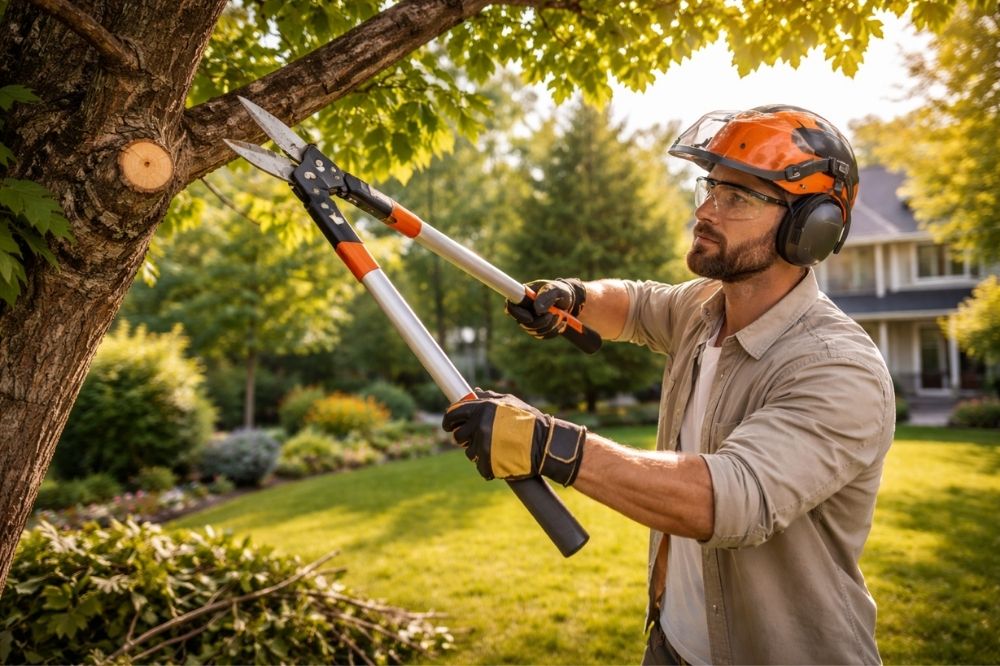
If you want to learn how to prune a tree, you are already doing your yard a favor. Good pruning keeps a tree healthy, safe, and looking sharp. Bad pruning can hurt it for years. The difference usually comes down to knowing where to cut and how much to take. So here is a plain tree pruning guide from folks who prune oaks and pines all over Metro Atlanta.
One quick note before we start. This post is about technique, not timing. If you want to know the best month to grab your shears, check our guide on the best time to trim trees in Atlanta. Today we are just talking about the cuts themselves.
What good pruning is really trying to do
Every cut you make is a small wound. The tree has to seal it over on its own. So the goal is simple. Make fewer, cleaner cuts that the tree can heal fast.
Learning how to prune a tree really starts here. You are shaping the tree, removing weak or dead wood, and letting light and air move through the branches. You are not trying to give it a haircut or make it smaller for the sake of it. When you prune with a reason behind each cut, the tree stays strong and storm season gets a lot less scary.
How to prune a tree: where to make the cut
This is the part most people get wrong, so slow down here. Look at where a branch meets the trunk or a bigger limb. You will see a slightly swollen ring of bark. That is the branch collar, and it is the tree's healing zone.
You want to cut just outside that collar. Not into it, and not out past it. Here is what to avoid:
- Flush cuts. Cutting flat against the trunk removes the collar and leaves a big wound that struggles to seal. It opens the door to rot.
- Leaving a stub. Cut too far out and you leave a dead stub the tree cannot heal around. Bugs and decay move right in.
Aim for that sweet spot right outside the collar. The tree will grow a clean donut of new bark over it, and that is exactly what you want.
The three-cut method for heavy limbs
Here is a big one for how to prune a tree without tearing the bark. If a limb is heavy, one straight cut from the top will let it fall early. As it drops, it peels a long strip of bark down the trunk. That wound is ugly and hard for the tree to fix.
The three-cut method stops that from happening. It takes about a minute once you get the hang of it.
- Cut one. A few inches out from the collar, saw partway up into the underside of the limb. Go about a third of the way through, then stop.
- Cut two. Move an inch or two farther out and cut down from the top. The limb breaks off clean between the two cuts, and your undercut keeps the bark from tearing.
- Cut three. Now you have a short, light stub left. Make your final cut just outside the branch collar, like we talked about above.
That is it. Big limb gone, no torn bark, clean wound the tree can seal.
How much to remove at once
It is tempting to go hard when you finally get out there. Try not to. A tree makes its food in the leaves, so cutting off too much at once starves it and stresses it out.
A good rule of thumb is to remove no more than about 25 percent of the canopy in a single year. On a young or already stressed tree, take even less. If you feel like you are hacking away, stop and step back. You can always prune more next season.
What to actually prune
So which branches earn a cut? Start with the wood that is clearly a problem, then move on to shaping.
- Dead, damaged, or diseased wood. This is always the first to go. If you are not sure a branch is dead or sick, our post on how to tell if your tree is sick can help you read the signs.
- Crossing or rubbing branches. Two limbs that rub each other open wounds all season. Pick the healthier one and remove the other.
- Water sprouts and root suckers. Those skinny shoots that pop straight up from limbs or out of the ground drain energy. Cut them off.
- Low branches over walkways. Anything smacking you in the face on the way to the mailbox is fair game.
Work slowly and keep looking at the whole tree between cuts. It is easy to get carried away on one side.
Tools and staying safe
You do not need a truck full of gear. A few good tools cover most jobs on smaller trees.
- Hand pruners for twigs and small growth up to about half an inch.
- Loppers for branches up to an inch or two, thanks to the long handles.
- A pruning saw for anything thicker.
- A pole pruner to reach a bit higher without a ladder.
Keep them clean and sharp. A sharp blade makes a clean cut that heals fast, and wiping the blades between trees keeps you from spreading disease.
Now the safety part, and please take it seriously. Never prune anything near a power line. That is a call to the pros or the utility, full stop. Be very careful on ladders, since a shifting limb can knock you off balance in a second. And do not top your trees. Cutting the whole crown back to stubs seems like a fix, but it creates weak regrowth and long-term decay. It is one of the worst things you can do to a tree.
When to call a pro
Knowing how to prune a tree also means knowing when to hand it off. If a job is big, high, or close to your house or a power line, stop and call someone with the right gear and insurance. Those tall Georgia pines and mature oaks are heavy, and a limb coming down wrong can wreck a roof or a shoulder.
That is exactly what our tree trimming and pruning team is here for, all across Cobb, Fulton, Cherokee, Gwinnett, and Forsyth.
If you would rather have it handled right the first time, give Stanton Tree Service a call at (470) 914-3402. We are happy to take a look and give you a free estimate.