
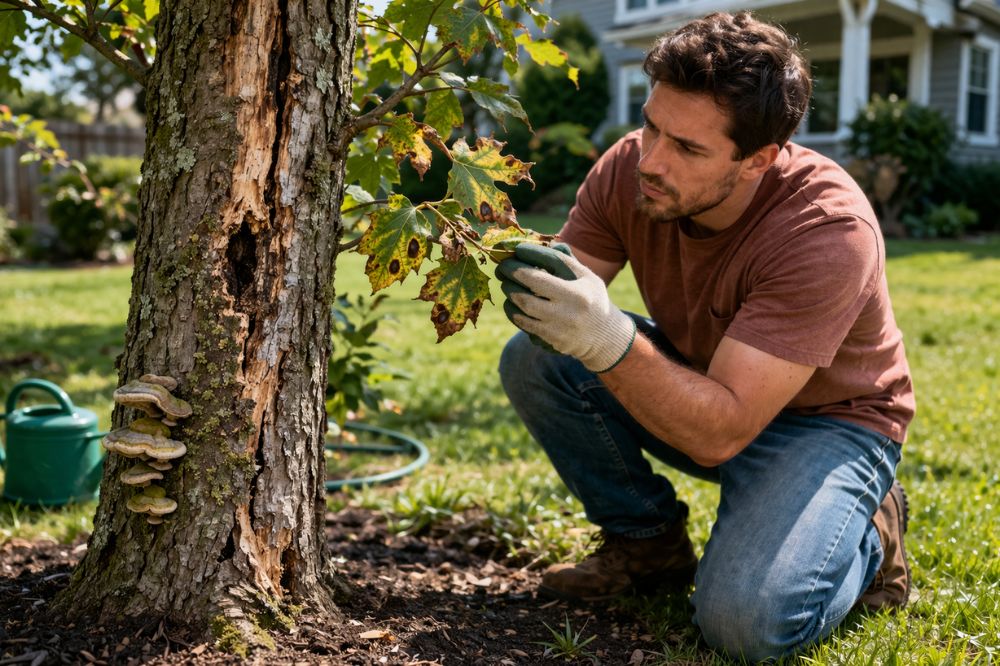
If your oaks are dropping leaves in July while the rest of the yard looks fine, you are not imagining things. Why is my tree losing leaves in summer is one of the questions we field most once the Georgia heat really sets in. Sometimes the tree is just protecting itself. Sometimes it is the first warning that something has gone wrong underground.
We work on trees all over Metro Atlanta, from Cobb and Cherokee down through Fulton, Gwinnett and Forsyth. Here is how to tell a tree that is coping from a tree that needs help.
Why is my tree losing leaves in summer? The short answer
A tree sheds leaves in summer because it is running short on water or healthy roots. Every leaf costs water to keep alive. When a tree gets stressed, dumping a few hundred leaves is cheaper than dying.
So summer leaf drop is a symptom, not a disease on its own. The real job is figuring out what is draining the tree.
Normal shedding or a real problem?
Not all of it is bad news. Big shade trees thin themselves out every summer, dropping the inner and lower leaves that sit in shade and never pay for themselves. You will see a light, steady sprinkle of yellow leaves from June through August. The canopy still looks full from the street.
Here is what separates routine shedding from trouble:
- Probably normal: Scattered yellow leaves, mostly from inside the canopy. The outer tips stay green and leafy.
- Worth watching: A heavy drop over a week or two after a hot, dry stretch, with browning along the leaf edges.
- Call somebody: One whole section of the canopy goes bare while the rest stays green. That lopsided pattern usually means a dead limb, a damaged root, or a problem in the trunk.
- Call today: Leaf drop plus mushrooms at the base, a soft spot in the trunk, or a new lean.
The usual causes around Atlanta
Drought and our red clay
This is the big one. Georgia red clay holds water tight when it is wet and turns to concrete when it dries out. After two or three rainless weeks in August, the top foot of soil can be bone dry even though the clay underneath still feels damp. Fine feeder roots live in that top layer, and they are the first to go.
Newer trees take the worst of it. Anything planted in the last three or four years has not spread its roots far enough to ride out a dry spell. A slow soak at the base, an hour or so once a week, does more good than daily sprinkler time.
Heat scorch
When leaves brown along the outside edges and between the veins while the center stays green, that is scorch. The tree simply cannot pull water up fast enough to keep up with a 95 degree afternoon. Scorched leaves do not recover, and the tree drops them. A healthy tree shrugs this off and leafs out fine next spring.
Root damage you cannot see
This one catches a lot of homeowners off guard. If you had a driveway poured, a pool dug, a fence line trenched, or heavy equipment parked near the tree in the last couple of years, the roots took a hit. Compacted clay suffocates roots. The canopy often looks fine for a season or two, then thins out during the first hard summer.
Roots that got cut during construction are a common culprit too. A tree can lose a surprising share of its root system and still look normal for a while, which is why the damage so often shows up years after the work was done.
Disease and fungus
Anthracnose shows up on oaks, maples and sycamores after a wet spring, leaving dark blotches along the veins before the leaves curl and fall. It looks alarming, but a strong tree usually pushes out a second flush of leaves and moves on.
Other fungal problems are more serious. If leaf drop comes with mushrooms, oozing bark, or dieback at the top of the tree, you could be looking at root or trunk rot. Our post on common oak tree diseases in Georgia covers what to look for, and how to tell if your tree is sick runs through the warning signs on any species.
Borers and pests
Stressed trees attract borers, and borers finish off stressed trees. Small round or D shaped holes in the bark, sawdust at the base, or woodpeckers suddenly working the trunk all point that direction. By the time borers move in, the tree is usually already in trouble.
What about oaks and maples specifically?
Oaks are the ones we get called about most. A mature water oak or willow oak losing leaves in summer is often dealing with root decline, and both species are notorious around here for looking healthy right up until a limb comes down. Water oaks in particular tend to hollow out from the inside while the canopy still looks decent.
Maples scorch easily because their leaves are thin and wide. A red maple in full afternoon sun on a clay bank will brown at the edges most Augusts. That is usually heat, not disease.
Pines play by different rules. Pines shed their oldest needles every fall, and some yellowing deep inside the tree is normal. Browning that starts at the top and works down is not normal, and that is worth a look right away.
What you can do right now
- Water deeply, not often. Let a hose trickle at the base for 45 to 60 minutes once a week during a dry spell. Move it around the drip line, not right against the trunk.
- Mulch properly. Two to three inches of mulch spread out to the drip line keeps the clay from baking. Keep it off the trunk. Mulch piled against bark holds moisture and rots it.
- Skip the fertilizer. Feeding a drought stressed tree pushes growth it cannot support. Wait until fall.
- Do not prune heavily in summer. Taking off live wood during heat stress makes things worse. Dead limbs can come out any time.
- Take photos. Snap the canopy now and again in two weeks. It is hard to judge thinning by memory.
When summer leaf drop means the tree has to come out
Most trees losing leaves in summer pull through. The ones that do not usually show other signs alongside the leaf drop: a hollow or soft trunk, big dead limbs over the roof, fungus at the base, or a lean that has gotten worse. One bad summer rarely kills a tree on its own. A bad summer on top of rotten roots often does.
If the tree is worth saving, selective pruning to clear out deadwood takes pressure off and usually runs $300 to $1,500 in Metro Atlanta depending on size and access. See our tree trimming and pruning services for what that involves. If the tree is past saving and sits near the house, removal in Atlanta generally falls between $900 and $2,500, with large removals over a roof or power line running higher.
A tree that drops its leaves is talking to you. Catching it the first summer is a whole lot cheaper than dealing with it after a limb lands on the garage.
Not sure what you are looking at? We will take a look free
If your tree is thinning out and you cannot tell whether it is the heat or something worse, have somebody put eyes on it. We are a licensed and insured family run company, and we have walked a lot of Metro Atlanta yards in August. Estimates are free and there is no pressure either way.
Call or text Stanton Tree Service at (470) 914-3402 for a free estimate. We will tell you straight whether your tree needs work or just needs water.