
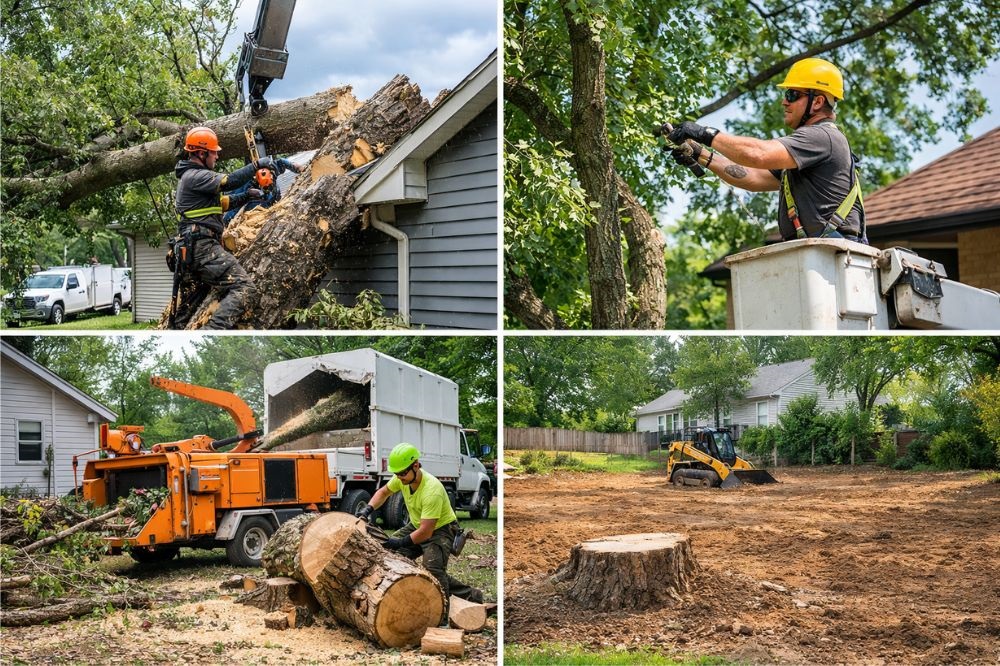
A tree fell on your house. Maybe it came down in the middle of the night with a crack like a gunshot, maybe you watched it go during a Thursday afternoon storm. Either way, you're standing in the driveway with your heart pounding and no idea what comes next. We've taken trees off roofs in Marietta, Roswell, Woodstock and Lawrenceville, and the homeowners who got through it with the least stress all did the same handful of things in the same order. Here's that order.
The first ten minutes: get out and stay out
Don't go back in for the laptop. A trunk that's resting on a ridge beam can shift again without warning, and the room under it is the last place you want to be. Get everyone out, pets included, and head to the far side of the yard or a neighbor's porch.
Then run three quick checks from a safe distance.
- If you smell gas, call Atlanta Gas Light's emergency line and 911. Don't flip any switches on your way out.
- If any power line is down or sagging, treat it as live. Stay 30 feet back and call Georgia Power. A limb across a line is their job, not yours or ours.
- If anyone is hurt, 911 before anything else.
If the tree came through the roof and it's raining, water is going to get in. That's a problem for later today, not for right now. Nothing in the attic is worth standing under a loaded trunk.
Who to call first when a tree fell on your house
This is the part people get backwards. The order that works is this: your insurance company, then an emergency tree crew, then a roofer. Call the insurer first because they'll open the claim, give you a claim number, and tell you whether they want their own adjuster to see the tree before it moves. Most carriers will say "make it safe and send photos," but ask, and write down who told you.
Next is the tree. A tree on a house is the one job you can't put off until Monday. Crews that do 24/7 emergency tree removal are set up for exactly this, with a bucket truck, rigging gear and sometimes a crane, and they can usually be on site within a few hours in metro Atlanta. If it's 2 a.m. and the tree is stable and the weather has passed, it's fine to wait for daylight. Nobody should be rigging a trunk off a roof by headlamp unless it's still moving.
The roofer comes third because they can't do much until the tree is off. A good one will tarp the hole the same day the tree comes down, and plenty of tree crews (ours included) will throw a tarp over the opening before they leave so you're not waiting.
Take photos before anything moves
Your phone is your best friend for the next week. Before the crew starts, walk the whole property and shoot everything: the tree on the roof from every side, the base of the trunk, the gutters, the fence it clipped, the car it missed by a foot. Get the inside too, the ceiling stains, the broken drywall, the wet carpet. Shoot a short video walking around the house while you narrate what you see.
Keep every receipt from here on. The tarp from Home Depot, the hotel in Kennesaw if you can't sleep at home, the pizza because the kitchen has a limb in it. Loss-of-use coverage pays for a lot of that, but only if you can show it.
The first day: getting the tree off the roof
A tree on a structure is a different job from a tree on the lawn. The crew can't just cut it into rounds, because every piece that comes off changes the weight on the roof. So they work from the tips back toward the trunk, lowering each section on ropes so nothing else drops through the shingles. On a big oak over a two-story house in Sandy Springs, that can mean a crane parked in the street and a full day of work.
Here's what emergency removal off a house runs in metro Atlanta right now. These are real bands from our own jobs, and your quote will land somewhere inside them depending on the tree, the roof and the access.
- Small tree or a single large limb on a one-story roof, no crane: $800 to $2,000
- Mid-size tree (40 to 60 feet) on the roof, rigged by hand: $2,000 to $4,500
- Large pine or oak on a two-story house, crane required: $4,500 to $9,000
- Crane day rate alone, when one is needed: $1,500 to $3,000 of the total
- Same-day tarping of the opening: $300 to $800
Storm pricing is higher than a planned removal, and it should be. The crew is working at night or in the rain, the wood is under tension, and the phone is ringing off the hook across Cobb and Fulton at the same time. What you should not see is a number that doubles because you sound desperate. If a quote feels wrong, call a second company. Any licensed tree removal crew will put the price in writing before they start, even at 11 p.m.
Does homeowners insurance pay when a tree falls on the house?
Almost always, yes, as long as the tree hit a covered structure. Your policy pays to get the tree off the house, repair the roof and the inside, and cover where you sleep while that happens. You'll owe your deductible, which on most metro Atlanta policies is $1,000 to $2,500, or a percentage of the home's value on newer wind and hail policies. Read the declarations page, because a 1 percent deductible on a $500,000 house is $5,000 before the carrier pays a dime.
The gray areas are the parts of the tree that did not hit anything. If half the oak is on your roof and half is across the lawn, the lawn half is often capped at $500 to $1,000 of debris removal. We wrote a whole post on whether homeowners insurance covers tree removal that walks through those limits in detail.
No insurance? You're paying out of pocket, and the honest move is to tell the crew up front. A good company will scope the job down to the minimum that makes the house safe and dry, and let you deal with the rest of the tree when you can.
The first week: adjusters, roofers and the tree that's still standing
The adjuster will usually come out within three to seven days. Have your photos, your receipts and the tree crew's invoice ready, and walk them through the inside damage yourself. They're looking at a lot of houses after an ice storm, and the things you point out are the things that get paid.
Get two roofing bids while you wait. After a big storm, out-of-state crews flood the subdivisions off 575 and 400 with flyers. Some are fine. Some will be gone before the first leak shows up. Use a roofer with a Georgia address and a real phone number.
Then look up. If a tree fell, the trees next to it went through the same wind on the same wet red clay. Walk the yard and check for leaning trunks, lifted soil at the base, and big limbs hanging by a strip of bark. Those are the ones that come down in the next storm, and a quick look from a tree pro now is a lot cheaper than doing this twice.
What if it was the neighbor's tree?
In Georgia, your insurance still handles it. Your carrier pays your claim, and they only go after the neighbor's policy if the neighbor knew the tree was dead or dangerous and ignored it. That's a high bar. We cover the whole situation in our post on what happens when a neighbor's dead tree falls on your house, including the letter you should send about any other tree you're worried about. Flip it around and the same rule applies: if your healthy tree lands on their garage, their policy pays.
If the tree brought a power line down with it, the responsibility question gets more complicated. Our guide to who is responsible when a tree falls on power lines sorts out the utility's share from yours.
A tree fell on my car instead
Same first steps, different policy. A tree on a car is a comprehensive auto claim, not a homeowners claim, even in your own driveway. Photograph it, call your auto insurer, and don't try to drag the limb off with a truck. The tree crew will lift it clear so the car can be towed or driven. Expect $300 to $900 for a limb off a car and more if the whole tree is on it.
Frequently asked questions
Can I stay in the house tonight?
Only if the tree is off the roof, or a tree pro has looked at it and told you the trunk is resting on the ground and the roof, not hanging. If the trunk is held up by the house alone, sleep somewhere else.
A small tree fell on the house at night. Do I need an emergency crew?
If it's small, nothing is leaking and no lines are involved, no. Take your photos, call the insurer in the morning, and get a regular quote. Save the emergency rate for a tree that's actually in the house.
Should I call insurance or the tree company first?
Insurance, unless the tree is still moving or there's a safety problem. The call takes ten minutes and gives you a claim number the tree crew can bill against.
Can the tree company bill my insurance directly?
Often, yes. Many metro Atlanta crews will invoice the carrier for the removal with your claim number and have you pay the deductible. Ask before the work starts, because the paperwork is easier if it's set up from the first call.
If a tree fell on your house in metro Atlanta and you want a straight answer on what it'll take to get it off, call Stanton Tree Service at (470) 914-3402. We answer around the clock during storm season, and the estimate is free. For more on how we handle storm work, see our page on storm damage tree removal in Atlanta.