
A storm rolls through Cobb or Gwinnett, you hear a crack out back, and now a big pine is laying across the line at the edge of your yard. The first question almost every homeowner asks is who is responsible when a tree falls on power lines. The short answer is that it depends on whose wire it is, whose tree it was, and where the damage actually happened. Here is how it really breaks down for Metro Atlanta homeowners, plus what to do in the first few minutes.
Who Is Responsible When a Tree Falls on Power Lines?
Start with the wire itself. The main line running along the street on the utility pole belongs to Georgia Power or your local EMC, not you. The service drop, the line that runs from the pole to your house, is usually the utility's property too, right up to the point it connects at your weatherhead or meter. Past that point, the wiring is yours.
Because the utility owns almost all of that wire, they are the ones who send a crew to cut power to the line, clear the tree off of it, and make everything safe again. That part is on them, and it will not show up as a bill to you. What happens to the rest of the tree, the trunk sitting in your yard and the branches scattered across the lawn, is a separate question.
Does It Matter Whose Tree It Was?
It matters for a different reason. Whose tree it was decides who pays to clean up and repair whatever got damaged. In Georgia, like most states, if a healthy tree comes down in a storm, your own homeowners policy usually covers your own property, even if the tree started out in your neighbor's yard. You file with your insurer, not theirs.
There is one big exception. If you can show your neighbor knew the tree was dead, leaning, or rotten and did nothing about it, that changes the picture. Your insurer may go after your neighbor's policy to recover what they paid out. We walk through that whole process, along with what counts as a covered claim, in our guide on does homeowners insurance cover tree removal.
What to Do the Moment a Tree Hits a Power Line
The first few minutes matter more than anything else. Downed lines are unpredictable, and a wire that looks dead can still be carrying a full charge.
- Stay back at least 30 feet from the tree and the line, more if you can.
- Treat every wire as live, even during a power outage. Lines can stay energized from backup circuits.
- Do not touch the tree, a fence, a car, or anything else that is in contact with the wire.
- Call 911 first, then report the outage to Georgia Power or your local utility.
- Keep kids and pets inside until a crew has cleared the scene and confirmed it is safe.
If the tree is blocking your driveway or leaning on your roof but is not touching any wires, it is still smart to wait for daylight and a clear head before anyone goes near it with a chainsaw.
What the Utility Handles vs. What You Handle
The utility company's job stops once the wire is safe and the power is back on. They will cut back or remove whatever part of the tree was tangled in the line, but they are not a tree removal service, and they will not clean up your yard. Once the line is clear, the trunk, the stump, and the debris pile are your responsibility.
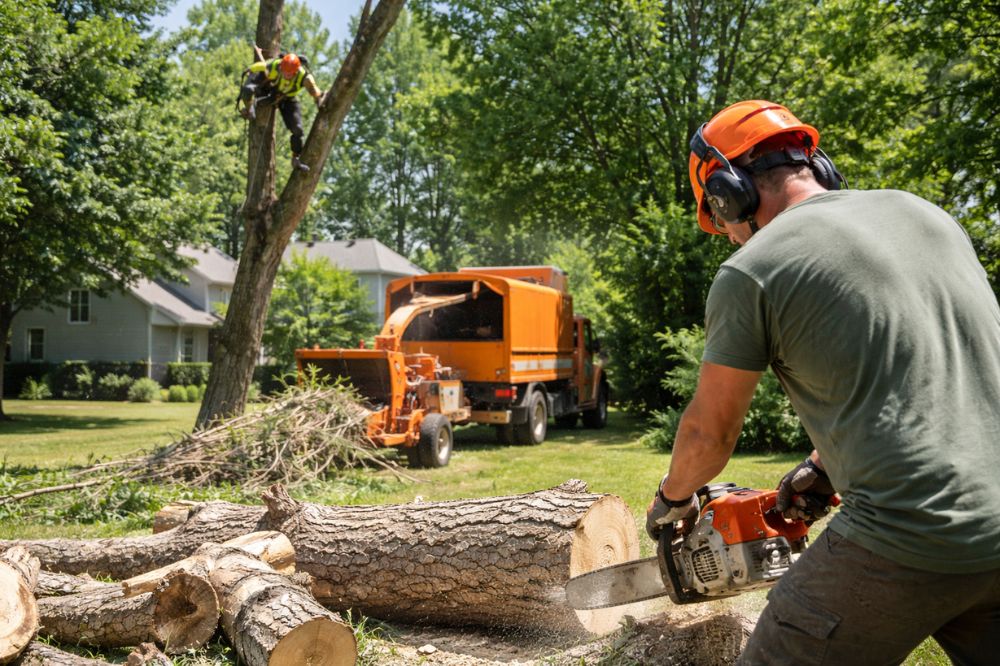
This is where a local tree crew comes in. We handle everything left after the utility clears the wire: cutting the trunk into manageable pieces, hauling off debris, and grinding the stump if you want the spot usable again. If the tree also damaged your roof, siding, or a fence, that repair work runs through your homeowners claim, separate from the tree removal itself.
What Removal Costs When a Tree Falls on Power Lines
Removal jobs near power lines usually cost more than a standard tree job because of the extra care involved. A typical residential tree removal in Metro Atlanta runs about $300 to $1,500. A large oak or pine that came down near a line, especially if branches are still tangled in wires the utility has not fully cleared, can run $1,500 to $3,000 or more. That higher price covers a crew trained in line-clearance work and the specialized rigging needed to bring pieces down without touching a wire.
Get more than one quote if you have time, and ask the crew directly whether they have line-clearance experience. It is not the kind of job for a weekend chainsaw and a ladder. Our Atlanta tree removal price guide breaks down cost by tree size if you want a fuller picture before you call anyone out.
Cutting Down the Odds of a Repeat
Georgia red clay does not drain fast, and after a wet spring, a lot of pines and oaks around Atlanta end up more top-heavy than their roots can really support. A tree leaning toward the street, or crowding the service drop that feeds your house, is worth a second look before storm season or a January ice storm makes the decision for you. Our guide on is a leaning tree dangerous covers the warning signs worth acting on early, before a tree falls on power lines instead of after.
Regular trimming keeps limbs away from the lines in the first place, which is usually cheaper and a lot less stressful than an emergency call at 2 a.m. during a storm.
If you already have a tree down near a line, or one that has started leaning the wrong way toward your service drop, Stanton Tree Service handles cleanup and removal across Cobb, Fulton, Cherokee, Gwinnett, and Forsyth counties. Call (470) 914-3402 for a free estimate, and we will tell you straight whether it is a today problem or one you can keep an eye on.