
Drive around Cobb or Gwinnett in late winter and you will see it everywhere. Crepe myrtles chopped back to knuckled stubs, like somebody got mad at them. Good crepe myrtle pruning looks nothing like that. Done right, it is light work that keeps the tree blooming hard all summer and leaves that smooth cinnamon bark showing. Done wrong, you get weak shoots, fewer flowers, and a tree that needs the same butchering every single February.
We prune a lot of these across Metro Atlanta. Here is what actually works in Georgia, and what to leave alone.
When to prune crepe myrtles in Georgia
Late winter. Around here that means mid-February into early March, after the hardest cold has passed but before the buds swell. The tree is bare, so you can see the structure you are working with. And since crepe myrtles bloom on new growth, anything you cut in February still has months to push shoots and set flowers by June.
Small cleanup can happen almost any time. Snapping off spent seed heads in early July often brings a lighter second flush of blooms in late August. What you want to avoid is heavy cutting in fall. Prune in October or November and the tree pushes tender new growth right as our first freeze rolls into Cherokee and Forsyth, usually mid to late in the month. That growth gets zapped, and you lose it anyway.
What crepe myrtle pruning should actually look like
Think of it as editing, not cutting back. Here is what comes off:
- Suckers at the base. Those thin shoots coming up from the roots and the bottom of the trunks. Cut them flush at ground level. They steal energy and muddy the shape.
- Crossing and rubbing limbs. Anything growing into the center or scraping a neighbor. Rub wounds are an open door for decay.
- Dead or broken wood. Easy call, and it can come off any time of year.
- Twiggy interior growth. Opening up the middle lets air move through. That matters in Georgia humidity, because powdery mildew loves a crowded canopy.
- Low side branches. If you want the classic vase shape with the trunks on display, lift the canopy gradually over a few seasons instead of all at once.
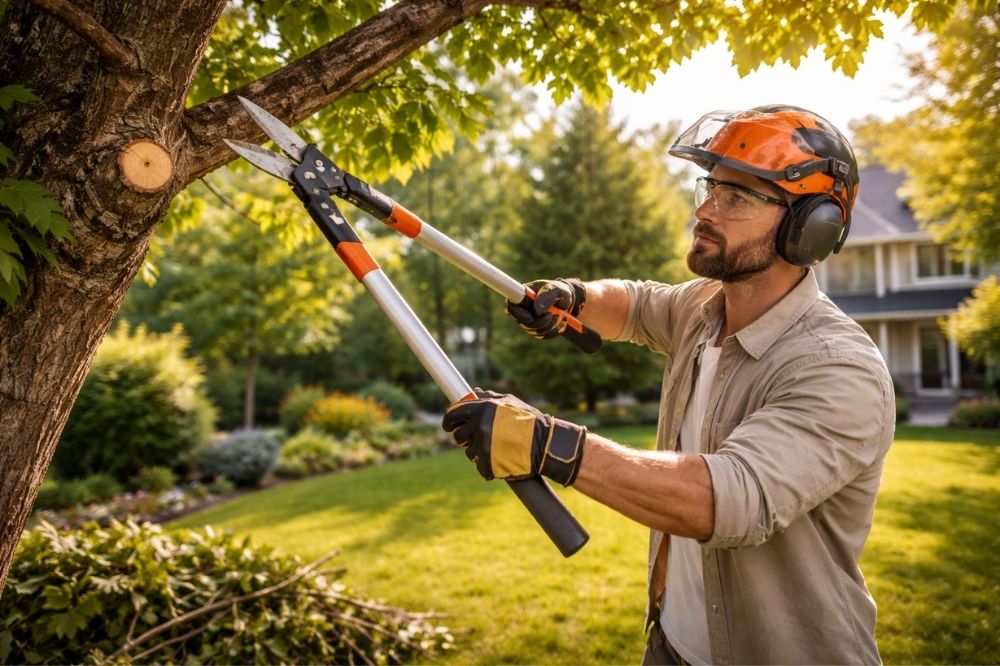
What stays is the main trunks, usually three to five of them, plus the natural arching branch structure above. Most crepe myrtle pruning is hand pruners and loppers, maybe a small hand saw. If you have reached for a chainsaw, something has gone sideways.
Crape murder, and why topping backfires
Cutting every trunk off at the same height, usually about four feet up, is so common down here that folks gave it a name. Crape murder. It is just topping, and topping hurts any tree. We have written about why topping is bad for trees, and crepe myrtles are no exception.
Top one and the tree panics, shoving out a dozen skinny shoots from each cut. Those shoots are weakly attached. They grow fast, get heavy with blooms, then flop over in the first July thunderstorm. The cut ends swell into knobby fists that never really close and slowly rot from the middle. You have also signed up for the job permanently, because next winter there are twice as many stubs waiting on you.
Plenty of people top because somebody told them it makes more flowers. It does not. You trade a full tree covered in blooms for fewer, heavier clusters on stems that cannot hold them up.
My crepe myrtle is too tall. Now what?
This is the real reason most of them get topped. Somebody planted a Natchez that wants to reach 25 feet, and they put it six feet off the porch. Topping will not fix that. It grows right back, usually faster and uglier.
Reduction pruning is the better move. Cuts get made back to a smaller side branch, so the tree keeps a natural outline at a lower height instead of ending in stubs. That holds for several years and does not set off the shoot explosion. Crown reduction and thinning work on the same principle for larger trees.
The other answer is the honest one. Sometimes the tree is simply in the wrong spot. A small one can be moved. On a mature tree, swapping it for a dwarf variety that tops out around 10 or 12 feet usually beats fighting it every February for the next 20 years.
Frequently Asked Questions
Why is my crepe myrtle not blooming?
Shade is the usual culprit. Crepe myrtles want six or more hours of direct sun, and a lot of Atlanta yards have slowly filled in with pine and oak canopy overhead. The other common causes are pruning too late in spring, which cuts off the wood that was going to flower, and too much nitrogen fertilizer, which gives you a beautiful green tree and no blooms. Powdery mildew and crepe myrtle bark scale can knock flowering back too.
When do crepe myrtles bloom in Georgia?
Most start in June and run into September, with the heaviest show in July. It varies by variety, and a tree pruned back in February usually flowers a little earlier than one cut late in spring.
How far back can I cut a crepe myrtle?
A good rule is nothing thicker than a pencil, or maybe your thumb on a big mature tree. If a branch is bigger than that and it is not dead or crossing something, leave it. Taking more than about a quarter of the canopy in one season puts real stress on the tree.
Can I cut my crepe myrtle all the way to the ground?
You can, and it will come back from the roots. This is sometimes done to restart a tree that has been badly butchered for years. You then pick out three to five of the strongest new shoots over the following couple of seasons and remove the rest. It takes patience, and you give up blooms for a year or two.
Is crepe myrtle pruning something I can do myself?
On a young or mid-size tree, yes. Hand pruners, loppers, and an hour on a Saturday will cover it. The job stops being a DIY project once you need a ladder to reach the cuts.
When to call somebody
Call a pro when the tree has outgrown what you can reach from the ground, or when it is anywhere near a power line. Ladder work with a saw overhead is how homeowners get hurt, and no crepe myrtle is worth a trip to Kennestone. A tree that has been topped for years also needs a real restoration plan, which takes a few seasons of careful cuts rather than one afternoon.
We handle tree trimming and pruning across Metro Atlanta, from Marietta and Roswell out to Canton, Duluth, and Cumming. Stanton Tree Service is family run, licensed, and insured. If you are not sure whether yours needs work, our guide to the best time to trim trees in Atlanta covers the timing for the rest of your yard too.
Want somebody to look at yours before pruning season hits? Call or text (470) 914-3402 for a free estimate. We will tell you straight whether it needs pruning at all, because now and then the right answer is to leave the tree be and let it do its thing.