
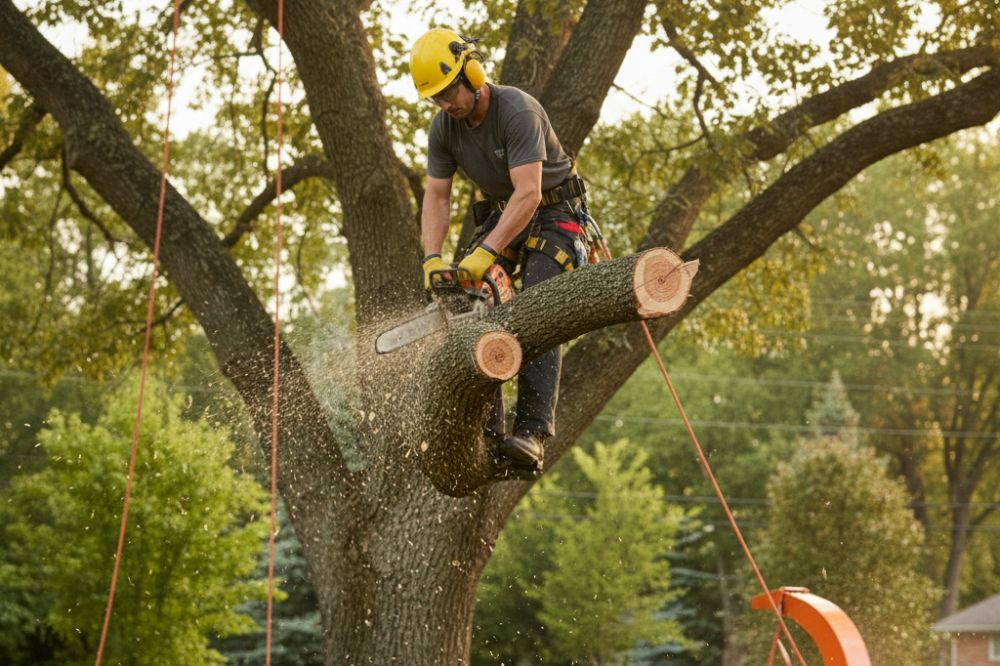
If a tree guy told you your big oak needs to come down a few feet, what you actually want is a crown reduction, not topping. It shortens the canopy by cutting limbs back to living side branches, so the tree keeps its shape and can still heal. Topping just lops the top off and leaves blunt stubs. Around Metro Atlanta, where tall water oaks and loblolly pines hang over roofs in Cobb and Cherokee, knowing which one you are paying for can save your tree.
What is crown reduction on a tree?
Crown reduction is pruning that lowers the height or the spread of a tree's canopy. A good arborist doesn't cut a limb wherever it's convenient. They follow it back to a smaller branch growing in a sensible direction and cut there. That side branch takes over the job. It keeps pulling sap, and the wound seals over in a season or two.
There's a rule most pros stick to. The branch you cut back to should be at least a third the diameter of the limb you're shortening. Go smaller than that and you've basically topped the tree with extra steps.
What does it look like afterward?
Look out at the branch tips. After a proper job you'll see cuts sitting right above a side branch that's still alive and leafed out. No flat stubs. No bare poles pointing at the sky. The canopy gets smaller, but the outline stays rounded and natural. Most neighbors won't even notice anything happened.
Crown thinning does something different
Folks mix these two up constantly. Crown thinning doesn't shrink the tree. It takes out a share of the smaller branches spread through the canopy so light and wind can move through it. Same height, same width. Just less dense inside.
Thinning is the right call when:
- Your grass won't grow because the canopy blocks every bit of sun
- The tree catches wind like a sail when storm season rolls in
- Crossing limbs are rubbing each other raw
- Dead or weak interior wood needs to come out
Reduction is the right call when the tree is simply too big for the spot it's in. Hanging over the roof, pushing into the power drop. On plenty of Fulton County jobs we end up doing some of both on the same tree.
Crown reduction vs topping
This is the question we get asked most, and the difference is bigger than it sounds.
Topping cuts limbs at a random point with nothing left to take over. The tree panics. It pushes out a thicket of fast, weak shoots called water sprouts, and those shoots are attached to dead stub wood instead of solid structure. Three or four years later you've got a taller, heavier, more dangerous tree than you started with, plus open wounds that never close. Our full write-up on why topping hurts your trees walks through what happens after.
A crown reduction leaves living branches in charge at every cut. The wood stays sound. Growth comes back slow and normal instead of in a panic.
How much can you safely take off?
Not as much as most people hope. On a healthy, mature hardwood, a good arborist takes no more than about 20 to 25 percent of the live canopy in one visit. On an older or already stressed tree, more like 10 to 15 percent. Georgia red clay doesn't hold water well through a dry August, and a tree that just lost a third of its leaves has a hard time feeding itself through that.
If a tree needs to come down more than that, we spread the work over two or three years. Nobody likes hearing it, but it beats killing a sixty-year-old oak to save one season.
What crown reduction costs in Metro Atlanta
Price mostly follows size and access. Rough ranges for our area:
- Small ornamental or young hardwood: $300 to $700
- Medium shade tree, 30 to 50 feet: $500 to $1,200
- Large mature oak or poplar over the house: $1,000 to $2,000
- Very large tree, tight access, heavy rigging: $1,500 to $3,500
Thinning the same tree usually runs a little less than a reduction, since there's less heavy wood coming out. A backyard with no gate access, power lines overhead, or a pool sitting underneath will push any of these numbers up. Our Atlanta tree trimming cost guide has more detail on what drives the bill.
When your tree needs something else entirely
Reduction and thinning fix a tree that's basically sound. They don't fix a tree that's failing. If you're seeing a big cavity at the base, mushrooms pushing out of the root flare, a sudden lean with cracked soil on one side, or large dead limbs through the upper canopy, pruning isn't the answer. That's a structural problem.
Sometimes a tree with a split trunk union can be saved with hardware instead of cuts. Our guide to cabling and bracing covers when that works. If the tree is past saving, tree removal is safer and cheaper than waiting for the next storm to do it for you.
Best time of year for it in Georgia
Late winter is ideal here, roughly January through early March. The leaves are off, so we can read the structure clearly, and the tree pours its energy into sealing cuts as soon as it wakes up. Oaks especially benefit from winter work, because cutting them in spring and early summer invites oak wilt and borers.
Storm-damaged limbs are the exception. Those come off whenever they break, summer heat or not.
Get a straight answer before anyone cuts
If a company quotes you on cutting the tree back without saying where the cuts will land, ask. A real reduction takes longer and costs more than topping, and the outfit doing it should be able to tell you exactly which branches they're cutting back to and why. If they can't, that tells you something.
Stanton Tree Service is family run, licensed and insured, and we work across Metro Atlanta. Call (470) 914-3402 for a free estimate. We'll walk your yard and tell you honestly whether your tree needs work at all, and you'll have the price in hand before anybody starts a saw.