
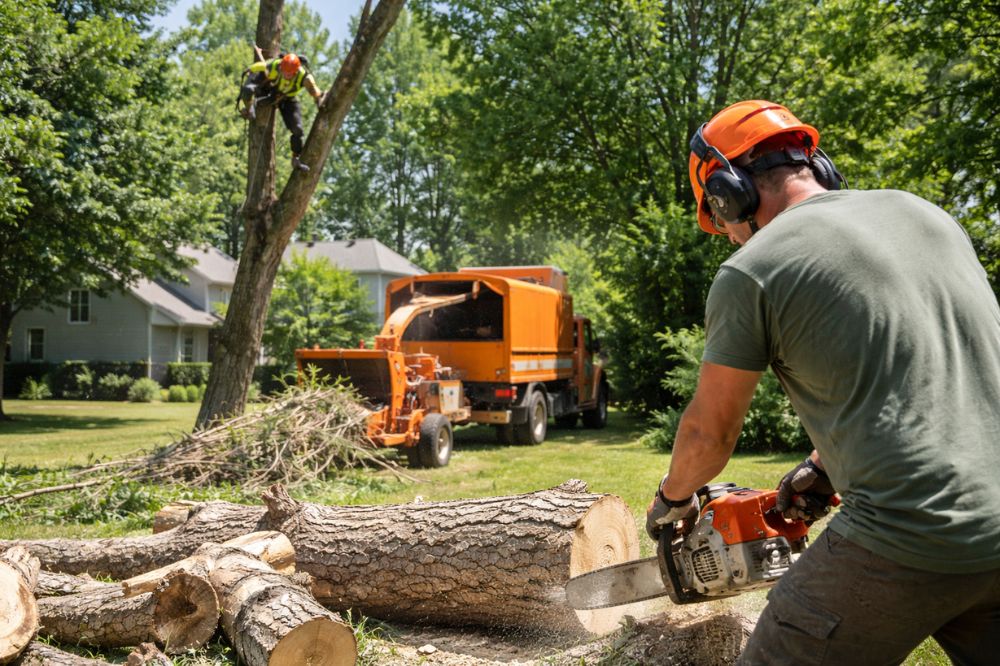
If you own a wooded lot in Metro Atlanta and you want a number before you build, fence, or just take your backyard back, the land clearing cost in Georgia usually falls between $1,500 and $7,000 per acre. Heavy ground with big hardwoods can run past $10,000. That is a wide spread, so let's walk through where your property is likely to land and why.
What land clearing actually covers
Folks use the phrase to mean a few different jobs. Sometimes it is a full acre of pines coming down for a house pad in Cherokee County. Sometimes it is knocking back twenty years of privet and sweetgum saplings behind a fence line in Marietta. The work normally includes dropping the trees, cutting them up, chipping or hauling the brush, and dealing with the stumps.
What it does not automatically include is grading, hauling in fill dirt, or seeding. Those get priced separately. Ask up front so the number in your head matches the number on the invoice.
Average land clearing cost in Georgia
Here is what we see across Cobb, Cherokee, Fulton, Gwinnett, and Forsyth right now. Prices are per acre unless noted.
Light clearing: $1,500 to $3,500 per acre
Grass, briars, brush, and a handful of small trees under about 8 inches across. A mulching head or a skid steer handles most of it in a day. If your land was pasture, or somebody cleared it within the last ten years or so, you are probably in this range.
Medium wooded: $3,500 to $7,000 per acre
This is the typical North Georgia lot. Loblolly pines, a few oaks, thick understory, and roughly 40 to 80 trees an acre that all have to come down and get chipped. Most homeowners clearing for a house pad, a shop, or a pasture land right here.
Heavy clearing: $7,000 to $15,000 per acre
Mature hardwoods, trunks over 30 inches, steep slope, wet bottomland, or a stream buffer you have to work around. Big wood is slow wood. It takes bigger equipment, more hauling, and more days on site, and the price follows.
Clearing part of a yard is different. Opening up a quarter acre behind the house or cutting in a driveway path usually runs $800 to $3,000 total. Small jobs get priced by the day, not by the acre, so a half day of work costs about what a half day of work costs no matter how you slice the acreage.
What pushes the price up
- Access. If a chipper truck and a skid steer can drive right onto the lot, you save real money. A narrow gate, a soft shoulder, or a neighbor's fence in the way means more hand carrying and more hours.
- Debris disposal. Hauling logs and brush to a dump site is often 20 to 30 percent of the bill. Chipping on site and leaving the mulch spread out is cheaper, and a lot of folks like having the mulch anyway.
- Stumps. Cutting trees flush is one price. Grinding or pulling the stumps is another. Full grubbing across an acre can add $1,000 to $2,500.
- Georgia red clay. Our clay turns greasy after a rain and equipment sinks in it. A wet week in spring can stretch a two day job into four.
- Slope. Anything steep slows the crew down and limits what machines can safely work the ground.
- Power lines and structures. Trees leaning over a service drop, a shed, or a septic field get taken down in pieces instead of felled whole. That is careful work and it costs more.
- Local tree ordinances. The City of Atlanta and several Metro cities regulate removal, and some require a permit or replanting even on your own property. Worth a phone call to your county or city before the saws start.
Stumps: grind them or pull them
On a lot you plan to build on, stumps usually get dug out and hauled off, because a rotting stump under a slab or a driveway is a problem later. On a yard you plan to mow, grinding is the better deal. Grinding runs about $100 to $400 a stump depending on size, and you can read our Atlanta stump grinding price breakdown for the details. We also cover the machines and the process on our stump grinding and removal page.
One thing worth knowing: grinding leaves a pile of chips and root wood in the ground. It is fine for grass, but it is not clean fill for a foundation.
Clearing a lot versus removing a few trees
Plenty of people call asking about land clearing costs in Georgia when what they really need is four or five trees gone. That is a different job and usually a cheaper one. Single tree work gets priced tree by tree, and you can see those numbers in our Atlanta tree removal cost guide.
The rough rule: under about six trees, price it as tree removal. More than that, or if the understory is thick enough that you cannot walk through it, clearing by the acre almost always comes out cheaper.
How to compare quotes without getting burned
Land clearing bids can look wildly different for the same lot, and it is usually because they cover different work. Before you compare two numbers, make sure both of them answer these questions.
- Are stumps included, and ground or dug out?
- Is the debris hauled off, chipped on site, or piled for you to deal with?
- Does the price cover the whole acreage or only the part you walked?
- Who handles the permit if your city requires one?
- Is the company licensed and insured, with a certificate you can actually see?
That last one matters more than the price. A crew dropping 80 foot pines next to your house with no insurance is a risk you do not want to carry. Our guide on how to choose a tree service company walks through what to ask.
Be careful with a bid that comes in way under everybody else. Around here that usually means stumps got left out, or the brush is going to sit in a pile at the back of your property for the rest of the year.
Get a real number for your property
Nobody can quote your land clearing cost in Georgia accurately from a satellite photo. Tree size, ground conditions, access, and what you want done with the debris all move the number, sometimes by thousands. We come out, walk the property with you, and give you a written price with the scope spelled out.
Stanton Tree Service is a licensed and insured family run company working across Metro Atlanta. Call us at (470) 914-3402 for a free estimate on your lot, and we will tell you straight what it takes and what it costs.