
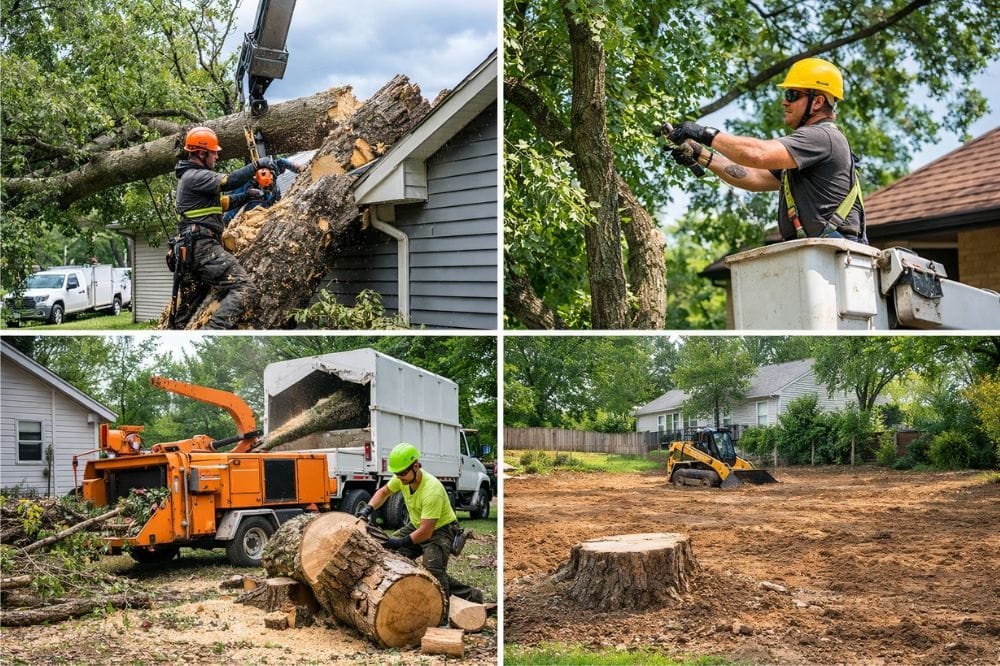
If you have a dead pine leaning over your deck in Marietta, you have probably already priced out a crew and then thought about doing it yourself. DIY tree removal is tempting. You own a chainsaw, the tree looks small enough, and a few hundred dollars saved is money back in your pocket. Sometimes that math works out fine. A lot of the time it doesn't, and the repair bill ends up bigger than the quote you were trying to dodge.
We drop trees all over Metro Atlanta, from Cobb and Cherokee out to Gwinnett and Forsyth. Here's the honest breakdown of what you can handle in your own yard, what you should hand off, and what each road actually costs.
When DIY tree removal actually makes sense
There's a real category of tree you can take down yourself without much drama. It looks like this:
- Under about 20 feet tall, and under 8 inches thick at chest height
- Standing straight with no lean
- Two full tree lengths of open ground in the direction you want it to fall
- No power line, fence, shed, driveway, car or roof anywhere in the fall zone
- Solid, healthy wood that won't split or kick back partway through your cut
- Level ground you can stand on without sliding around
Young sweetgums, volunteer privet, a scrubby little pine along the back fence. If you can walk a full circle around it and see nothing but grass in every direction, a decent saw and a helper standing well clear will get it done.
When to put the saw down and call somebody
Most of the trees homeowners call us about fail that checklist on the first or second line. If any of these describe your tree, the risk isn't worth the savings.
- Anything close to a power line. Georgia Power's service drops run through yards all over Fulton and DeKalb, and wood conducts once it's wet. This isn't a judgment call. Stay off it.
- Anything leaning toward a house, garage or fence. A leaning trunk is already loaded with tension, and it will not fall where your notch says it should.
- Dead, hollow or storm damaged wood. Dead pines are the big one in our area. The trunk can be sound at the base and punky 15 feet up, so the top breaks off while you're still cutting.
- Anything that needs you to leave the ground. Ladder work with a running saw sends people to Grady every storm season. Climbing and rigging is a trained skill with a harness, ropes and a groundman.
- Mature pines and oaks over roughly 30 feet. A 70 foot loblolly weighs several tons. There is no version of that tree you steer with a wedge and hope.
How big a tree can you cut down yourself?
The rule we give neighbors is simple. If the tree is shorter than the open space you have, it's a yard project. Once it's tall enough that its top could reach something you'd have to repair, it's a crew job. Height matters more than trunk thickness, because height decides your margin for error.
What DIY tree removal really costs in Georgia
People assume doing it yourself is free. It isn't. Here's what a first timer spends before a single cut:
- Chainsaw rental runs about $50 to $90 a day, or $200 to $450 to buy a homeowner grade saw
- Chaps, a helmet with a face screen, gloves and ear protection add $150 to $300
- Felling wedges and a decent pull rope run another $40 to $100
- Hauling the debris off costs $50 to $150 per truckload at a county yard waste site, and a mature pine is several loads
So a one time DIY tree removal on a small tree lands somewhere around $300 to $600 once you count gear and disposal, plus your whole Saturday. If the tree goes the wrong way, add a roof or fence repair at $1,500 to $8,000, and your deductible on top.
What a pro costs around Metro Atlanta
Our pricing isn't a mystery, and it's often closer to the DIY number than folks expect:
- Small trees under 25 feet: roughly $300 to $700
- Medium trees 25 to 50 feet: roughly $700 to $1,500
- Large pines and oaks over 50 feet, or anything tight to a house: $1,500 to $4,000 and up
That includes the climbing, the rigging, the cleanup and hauling everything away. For a fuller breakdown by size and access, see our Atlanta tree removal cost guide.
Will homeowners insurance cover a DIY job that goes wrong?
This is the question people ask us after the fact, and the answer usually disappoints. Most policies cover sudden accidental damage, so there's often something there if your tree clips your own roof. What they generally won't cover is damage you caused to a neighbor's property through work you weren't qualified to do, and some carriers push back hard on claims tied to homeowner tree work.
A licensed and insured company carries general liability and workers comp for exactly this reason. If our crew drops a limb through your gutter, that's on our policy, not your deductible. Ask any company you call for a current certificate of insurance before they start.
Do you need a permit to take a tree down?
Often, yes. The City of Atlanta has one of the stricter tree ordinances in the Southeast, and removing a healthy hardwood over a certain diameter needs a permit and sometimes a recompense fee. Plenty of surrounding cities and HOAs have their own rules. Cutting first and asking later can mean a fine well past what the removal would have cost. We walk through the process in do I need a permit to remove a tree in Atlanta.
What about the stump?
Dropping the tree is half the job. The stump is the half nobody plans for. Grinding it out by hand means a rented grinder at $100 to $200 a day plus a steep learning curve, and our red clay packs hard around old roots. Chemical stump killers take months and still leave the wood sitting there. Having it ground when the crew is already on site usually runs $100 to $300 per stump and takes under an hour. Here's more on our stump grinding and removal services.
Why Georgia makes this harder than a YouTube video looks
Two things work against homeowners here. First, our red clay goes slick the moment it rains, and wet clay around a root plate means a tree can shift while you're cutting it. Second, we grow tall pines with the weight way up high and very little taper. A pine looks easy from the ground because the trunk is straight and narrow. All the mass is 60 feet above your head, and that's what decides where it lands.
A simple way to decide
Stand in your yard and ask one thing. If this tree fell in the worst possible direction, what would it hit? If the answer is grass, go ahead and cut it. If the answer is anything you'd have to call a contractor about, the removal is cheaper than the repair.
Not sure which side of that line your tree falls on? We'll come look at it and tell you straight, including when a tree is small enough that you really can handle it yourself. Call Stanton Tree Service at (470) 914-3402 for a free estimate, or read more about our tree removal in Atlanta. We're a family run, licensed and insured crew, and the estimate costs you nothing.