
A Familiar Sight in Every Metro Atlanta Subdivision
Drive through almost any neighborhood in Cobb, Gwinnett, or Forsyth County in late March and you will see rows of white blooming trees lining the streets. Nine times out of ten, that is a bradford pear tree. Builders planted them everywhere in the 1980s and 90s because they grew fast, bloomed early, and looked neat and tidy on a landscape plan. Nobody planted them because they were built to last.
That is the root of most bradford pear tree problems homeowners deal with today. A tree that looked perfect on a builder's site plan turns into a liability twenty or thirty years later, and a lot of Atlanta yards are hitting that mark right now.
Why Bradford Pear Trees Split So Easily
The biggest issue with a bradford pear tree is how it is built. The main branches grow out from the trunk at a tight, narrow angle instead of a wide, sturdy one. Where those branches meet, the bark grows inward instead of forming a strong union. Arborists call this bark inclusion, and it is basically a built-in weak spot.
Add fast, soft growth on top of that structure and you get a tree that looks full and healthy right up until it is not. In a hard Georgia thunderstorm or a February ice event, that weak union gives out. Whole limbs, sometimes half the tree, come down without much warning.
This is why so many of our storm calls after a summer downpour or an ice storm involve a bradford pear tree that has split right down the middle. If yours has already cracked or dropped a major limb, that is not something to wait on.
The Real Bradford Pear Tree Problems
Weak Branch Structure
As covered above, the narrow branch angles are the main structural flaw. It is not a disease or a pest. It is just how the tree grows, and there is no pruning trick that fixes it once the tree is mature.
They Spread on Their Own Now
Bradford pears were sold as sterile, meaning they could not reproduce. That held true as long as only Bradford pears were planted nearby. Once other callery pear varieties showed up in the same neighborhoods, cross pollination happened, and the trees started producing viable seed.
Birds eat the small fruit and spread the seeds into fields, fence lines, and roadsides. Those seedlings grow thorny and aggressive, crowding out native trees. This is why you will hear people call bradford pear trees invasive, and honestly, at this point in Georgia, that label fits.
That Smell in Spring
Those pretty white blooms carry a smell a lot of people compare to rotting fish. It only lasts a week or two each spring, but if your tree sits close to a porch, driveway, or bedroom window, that is not a fun couple of weeks.
Georgia Is Cracking Down on Bradford Pears
Georgia lawmakers passed a ban on the sale of Bradford pear and other callery pear trees, taking effect in 2025. Several counties and cities across the state have also promoted bounty or exchange programs, offering homeowners a free native tree in return for removing an invasive Bradford pear. That should tell you something about how the tree is viewed by the people who study this stuff for a living.
Signs Your Bradford Pear Needs to Come Down
Not every bradford pear tree needs to be removed today, but watch for these signs:
- A split trunk or a major limb that has already come down
- Multiple trunks fused together at a tight, narrow angle (very common on this species)
- A lean that is new or getting worse, especially toward the house, driveway, or a fence
- A hollow sound when you tap the trunk, or fungus growing at the base
- The tree is more than 15 to 20 years old, which is about when Bradford pears start failing structurally
If you are seeing two or more of these, get it looked at before the next big storm rolls through, not after.
What to Plant Instead
If you are taking a Bradford pear out, you do not have to leave a bare spot in the yard. Native or well-behaved alternatives that handle Georgia red clay just fine include eastern redbud, serviceberry, dogwood, and tulip poplar for a bigger shade tree. All of them have stronger branch structure and none of them will spread into the woods behind your house.
Removing a Bradford Pear the Right Way
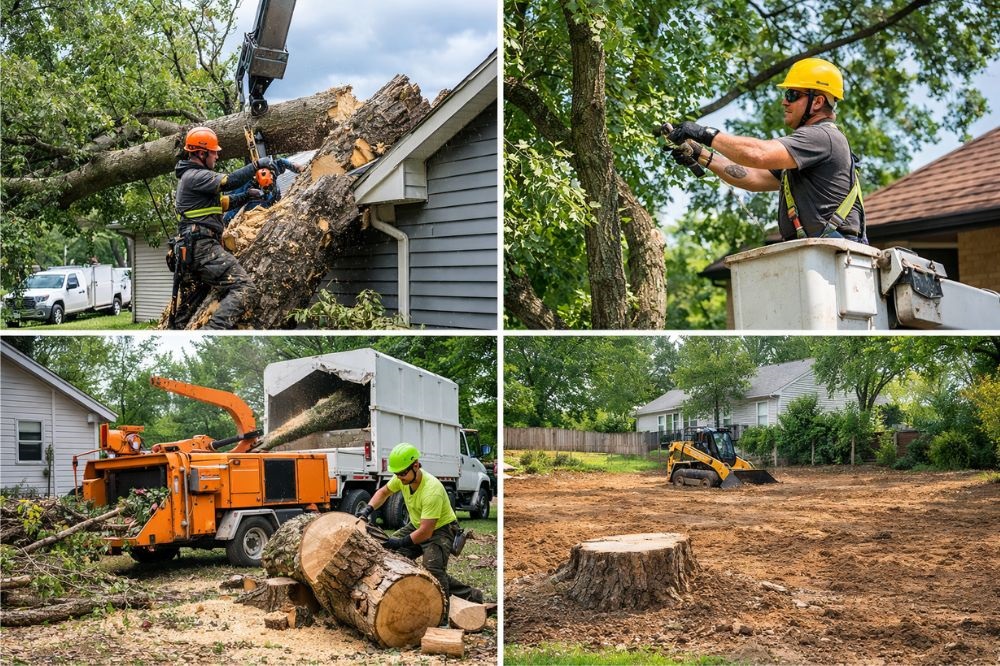
Because of that weak wood and narrow branch structure, a mature Bradford pear is genuinely more dangerous to cut down than a lot of hardwoods its size. Limbs can shift or drop mid-cut in ways a healthy oak or maple would not. This is one where calling in a professional tree removal crew is worth it rather than pulling out the chainsaw yourself.
Cost depends on the tree's size, how close it sits to your house, and whether the trunk has already split. Most Bradford pear removals fall on the lower to middle end of the range in our Atlanta tree removal cost guide, since the wood itself is soft and easy to cut once it is safely down. After the tree is gone, we can usually grind the stump the same visit so you are ready to plant something better in its place.
Got a Bradford pear that is leaning, split, or just past its prime? Call (470) 914-3402 for a free estimate. We will take a look, tell you straight whether it needs to come down now or can wait, and get you a fair price either way.